

A key finding of this year's report is that the Earth's energy imbalance – which measures how fast heat is accumulating in the climate system – has reached a record high.
“Without human influence, the Earth’s energy imbalance should be close to zero, but it has been growing since the 1970s and is now at a record high, doubling in recent decades,” says Piers Forster, Director of the Priestley Centre for Climate Futures at the University of Leeds and lead author of the report.
This growing heat accumulation is driving changes across the climate system, including accelerating sea level rise, increasing ocean temperatures and more frequent marine heatwaves.
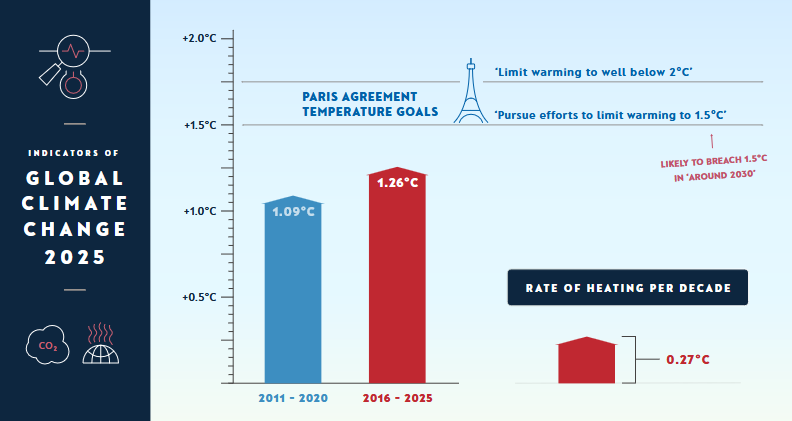
At the same time, global greenhouse gas emissions reached a record 56.8 billion tonnes of CO₂-equivalent in 2024. The rate of human-induced warming remains at around 0.27°C per decade, driven primarily by these record-high greenhouse gas levels.
The remaining carbon budget for limiting warming to 1.5°C has shrunk to around 130 billion tonnes of CO₂ from the beginning of 2026. At current emissions levels this budget would be exhausted in roughly three years.
“The planet keeps on warming as a result of human activities,” says William Lamb, PIK researcher and lead author of the report’s greenhouse gas emissions section. “With global greenhouse gas emissions at an all-time high, it is more important than ever for countries to reduce their emissions as fast as possible. Germany, for example, has cut emissions in half since the 1980s, but it still has a long way to go. Renewables offer a pathway to clean, reliable and secure energy supplies, but a rapid scaling of these systems is now needed to limit warming to 1.5°C.”
“Indicators of Global Climate Change” provides an annual assessment of key indicators of the state of the climate system.
Report:
Forster et al. (2026): Indicators of Global Climate Change 2025: annual update of key indicators of the state of the climate system and human influence. Earth System Science Data. DOI: 10.5194/essd-18-3889-2026
Link to full report:
https://essd.copernicus.org/articles/18/3889/2026/essd-18-3889-2026.pdf
Contact:
PIK press office
Phone: +49 331 288 2507
E-Mail: press@pik-potsdam.de
Web: www.pik-potsdam.de/en
Social Media: www.pik-potsdam.de/socials