

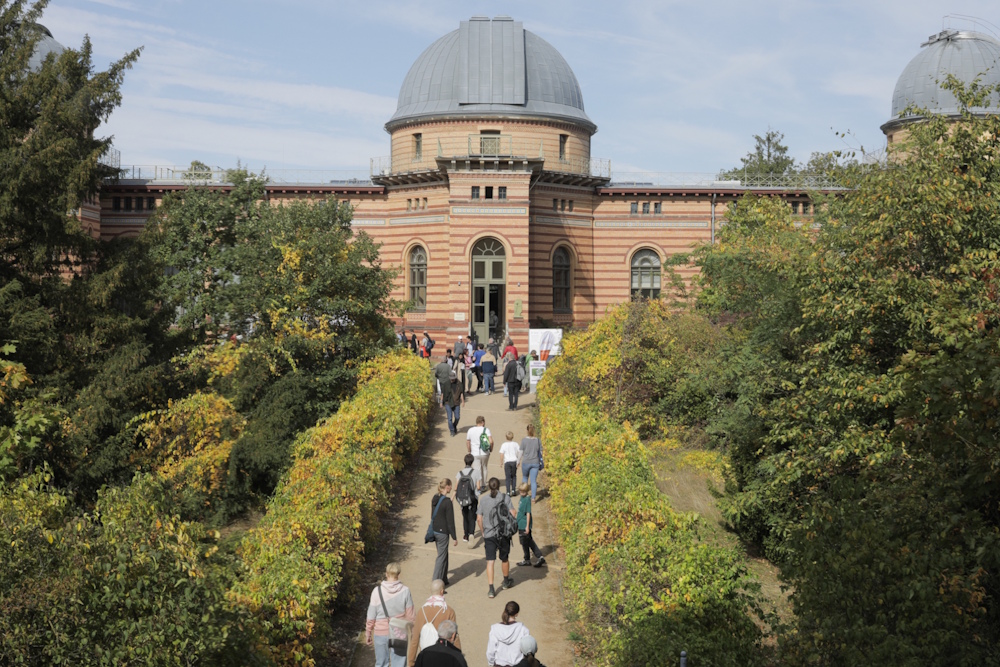
About 3,500 visitors of all ages took advantage of the event to find out more about the work of the four institutes. A photo gallery with highlights from the day can be found here.
“The Potsdam Institute bears our city’s name – and despite all our international activities, our local and regional roots are of great importance to us,” comments Bettina Hörstrup, Administrative Director of PIK. “It was a great pleasure to see just how vibrant this relationship is. At the open day, our researchers reported that the rooms the talks and hands-on activities were packed to capacity, and that there were numerous discussions – some of them long and in-depth – at the information stands. We would like to thank the many visitors from Potsdam, Brandenburg and Berlin for their curiosity and for making this an unforgettable day.”
Click here to visit the joint event website, and here for the full programme. PIK’s contribution to the overall programme included the following 15 items:
- Drought and the risk of forest fires in Brandenburg and around the world – coincidence or climate change?
Since 1893, the Potsdam Secular Observatory has been measuring rainfall here on the Telegrafenberg. It has recorded record-breaking drought and, consequently, a risk of forest fires in Brandenburg. We have also been confronted with harrowing images of fires across Europe and around the world this summer. Is this the “climate crisis”? What science knows about the link between weather and climate. (Christopher Reyer, Thirza van Laar) - Why did the dinosaurs become extinct?
Specially tailored to the young (and young-at-heart), we offer a journey back in time to 66 million years ago, when the dinosaurs became extinct after dominating life on Earth for around 150 million years. What do we know about this event? And what lesson does it offer for the present day? (Georg Feulner) - World climate conference
Take a seat at the negotiation table to lower greenhouse gas emissions. How would the Paris Agreement have looked if you had been representing a country? Our computer simulation allows you to calculate your proposals in seconds. Together we evaluate the results and find out whether more cooperation could have been possible. (Detlef Sprinz, David Zolotov) - Four billion years of climate history in 30 minutes
Why has the climate changed over the history of the Earth? How does the current climate crisis – caused by humans – compare to the past? Can looking back teach us something about the future? This lecture provide an entertaining description of Earth’s climate history, based on sound science, from its beginnings to the modern age. (Georg Feulner) - Climate tipping points in the earth system
An exciting lecture, already tested with grade 10 classes in schools. What you need to know about tipping points and vicious cycles in the Earth system – from polar ice caps and permafrost to rainforests and ocean currents. Why every tenth of a degree of global heating counts. And the good news: there are also positive tipping points. (Valeriia Chorna) - Nutrition, the underestimated area for action in climate protection
Based on a large research project, our expert explains, what contribution the global agrifood system can make in the fight against global heating. An important element is the “Planetary Health Diet”. There is plenty of time for questions and discussion following this exciting presentation. (Benjamin Bodirsky) - The contentious issue of fuel and heating costs – can the climate transition in Germany be managed in a socially equitable way?
Oil and gas heating and cars with internal combustion engines are soon to become a no-go, but who is supposed to pay for the switch to fossil-free technologies? Find out about concepts – developed at PIK and widely noted by politicians – that aim to bring climate protection and social justice together under one denominator. There is an opportunity for personal conversations following the lecture. (Karolina Rütten) - How the AMOC – the Atlantic’s giant heat pump – works
The AMOC – the vast Atlantic heat pump that transports enormous masses of water from the Southern to the Northern Hemisphere – is of vital importance to the global climate. It ensures a mild climate in Europe, and it is important that it remains stable in the future. We demonstrate how this works in our“ocean current experiment”, which invites you to get involved and discover more.
- Get ready for discussions with your friends: with the educational game “Climate Excuses”
“Too expensive”, “pointless”, and “others should do more”: people who want to put the brakes on climate action make various arguments. Our researchers have carried out a scientific analysis of these in a renowned specialist journal – and used the findings to develop an unusual entertainment experience. Come along and give it a go !
- Try it for yourself: how equitable climate action can be achieved in 88 countries
Carbon pricing is regarded as a key instrument of climate policy – it makes emission-intensive products more expensive and thus steers consumption and investment in a more climate-friendly direction. But who ends up footing the bill? Low-income earners or the wealthy? And what are the consequences if the state takes the revenue from carbon pricing and returns it to the public? A unique tool makes the findings from our research accessible in an interactive way. - Climate impacts at a glance
What can we expect in Brandenburg over the coming decades, and what is the situation elsewhere? Among other things, the interactive portal shows trends in record-breaking heatwaves and how mitigation measures can slow down this trajectory. Where will we be able to go on holiday in future? Where does the rainwater go? These are the questions we ask ourselves when they affect us directly. - Can you make the food system climate-friendly by 2050?
Start your challenge on our scientifically backed app...under expert guidance, of course. You can take various measure over six rounds of the game, you can take various measures, but be careful! As we all know, nutrition is a politically sensitive issue. Voters reward improvements and penalise crises. How will you fare? You can find out more about the study behind the game at the talk “Nutrition – the underestimated area for action in climate protection” (#6). - What is the state of the Planet Earth?
Of the nine “Planetary Boundaries” that define humanity’s safe operating space, seven have now been exceeded. On our “PB Science Spinning Wheel”, you can explore this important analytical concept in a fun way, answer quiz questions and, if you succeed, even pick up a small reward. - Photovoice: The climate crisis through the eyes of the Maasai
The indigenous Maasai communities of East Africa are being forced to adapt their traditional way of life – which is heavily dependent on the ecosystem – to the increasingly unpredictable climate. Visitors to this impressive and thought-provoking exhibition, which utilises the “Photovoice” method, are invited to discover 12 large-format photographs and accompanying narratives from the Maasai themselves and, of course, to speak to our researchers about their experiences in the field. - The famous Michelson experiment
In 1881, in the cellar of what is now the Michelsonhaus, Albert Abraham Michelson first demonstrated his interferometer for which he was awarded the Nobel Prize in 1907. His experiments provided support for the theory of relativity, and the interferometer’s principle is still used today to detect gravitational waves, amongst other things. A replica of Michelson’s legendary experiment can be viewed at the original site. (In collaboration with the AIP)
Further information
Press release from our neighbouring institute GFZ summarising the entire event: here
Contact:
PIK press office
Phone: +49 331 288 2507
E-Mail: press@pik-potsdam.de
Web: https://www.pik-potsdam.de/en
Social Media: https://www.pik-potsdam.de/socials