
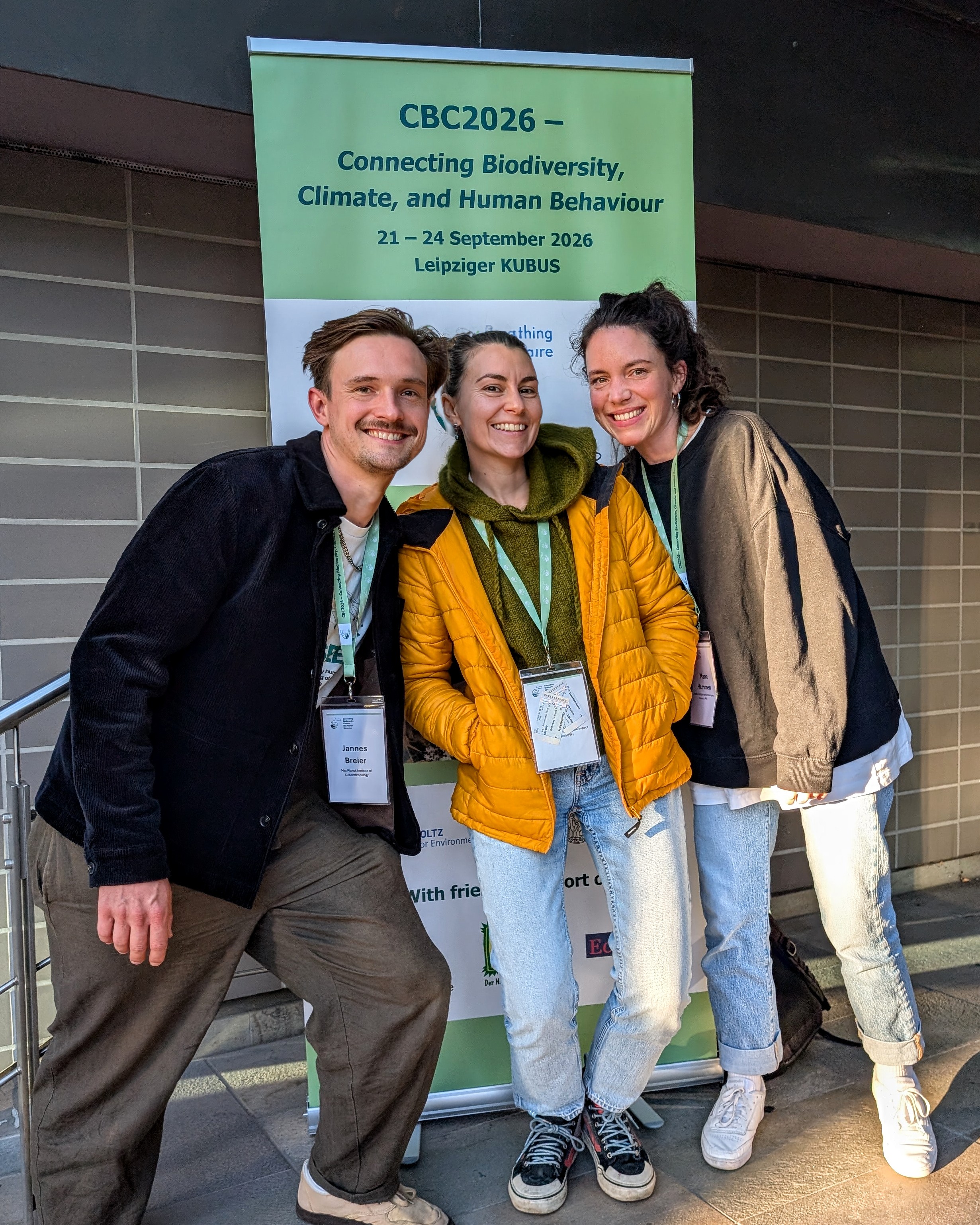
Climate change, biodiversity loss and human behaviour are deeply intertwined — but the field that studies all three as one system is still forming. CBC2026, initiated by the Central German "Breathing Nature" consortium and co-organised by the UFZ and Leipzig University, brought 275 researchers from 30 countries to the Leipziger KUBUS for 180 talks and 80 posters across biodiversity, climate and behavioural science. PIK and Max Planck Institute of Geoanthropology (MPI-GEA) contributed from the global modelling side of that conversation.
The behavioural half came from InSEEDS, an agent-based model for farmer decision-making coupled to the global biosphere model LPJmL. Jannes Breier (ERSU, MPI-GEA) showed what changes when farmers are left to decide for themselves — judging practices on what their own fields deliver and on what neighbours seem to be getting.
What those farmers can see is itself a modelling choice, which is where a joint project with Marie Hemmen and Christoph Müller (Land Biosphere Dynamics - LBD, RD2) comes in: Canopy temperatures can deviate substantially from the 2 m air temperatures used as a standard input to heat stress processes, and Marie's resource-efficient approach enables to simulate and use canopy temperatures to trigger modelled heat stress globally. Coupled into InSEEDS, heat damage now reaches the farmer's decision directly — a neat piece of cross-RD work, with an RD2 process running inside an ERSU decision model.
Delphine Tardif (ERSU) brought the biosphere's resilience into the room. Her poster introduced the different steps of the Tipping Points Modelling Intercomparison Project (TIPMIP) with experiments for Earth System Models, Dynamic Global Vegetation Models and a prospective extension to trait-based vegetation models. These complementary experiments aim at understanding coupled responses in the Earth system and whether functional diversity buffers the biosphere against climate extremes.
Farmers, leaves and traits: three things global models usually hold still, and three reasons not to.