

Posted: December 2026
Contact: Tim Repke
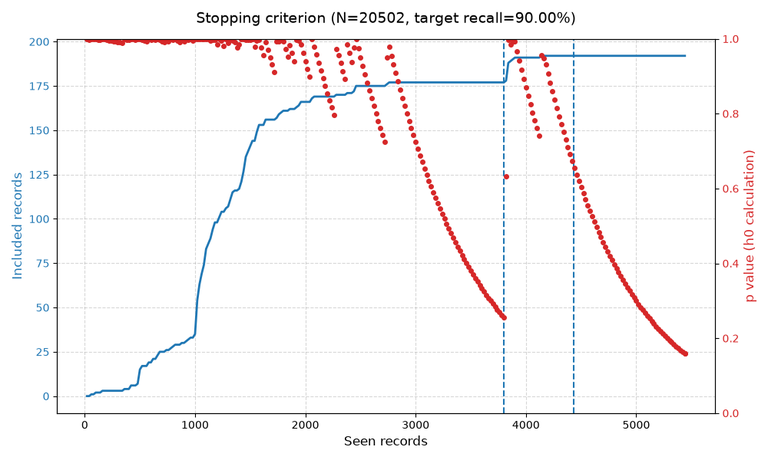
In evidence synthesis, we usually start with a large search on an academic database and then go through the results to annotate if they are actually relevant for our specific research question. Doing this by hand is far too labour intensive, so we use machine learning to prioritise what we screen. We also have stopping criteria to help us save work.
Research questions
- How can we use available information (e.g. existing annotations, model predictions, changes in model predictions) to project the estimated workload?
- How can we visualise complex statistical models with a large parameter (assumption/precondition) space and communicate the implications?
- How can we efficiently (pre-)compute (and cache) potentially complex simulations?
Prior work
- Stopping method paper
- Implemented methods
- Simulation data
- Living stopping methods (work in progress)
- More background information
Proposed tasks
To get started, here are a few ideas on how to get a better sense of the scope
- Interactive plot of the existing annotations (number of relevant over number of seen references)
- Build engine for simulating predicted trajectories
- Calibrate different trajectories based on currently seen references
- Implement additional statistical predictors
- Incorporate stopping methods to show where they would stop on the trajectories under which conditions
- Incorporate machine learning ranking scores into predicted trajectories
Useful skills: js, python
Useful prior knowledge: ML, statistics