

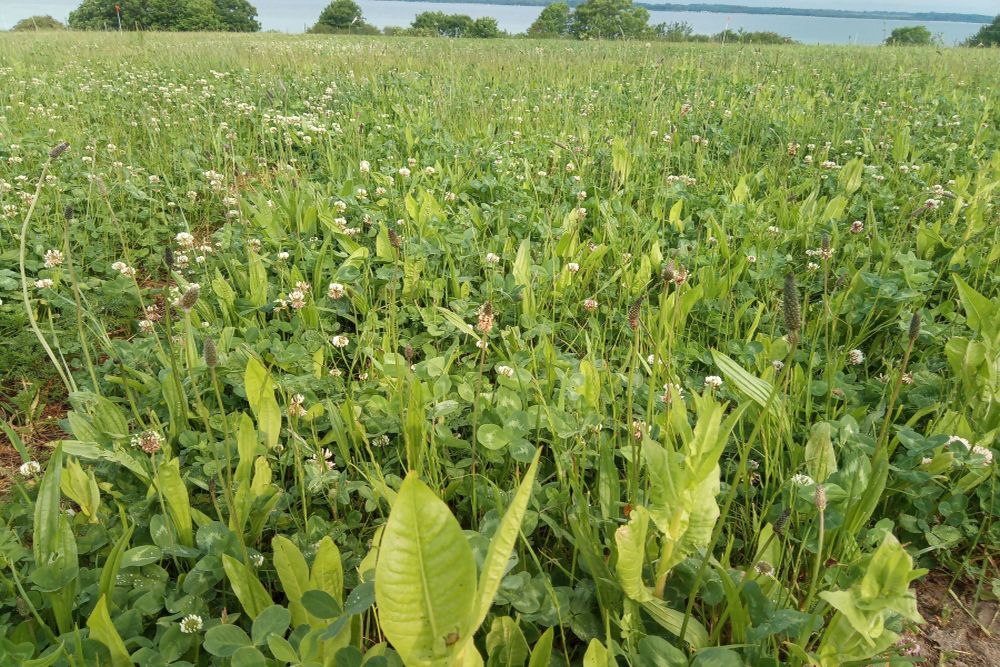
“Climate change could reduce the productivity of plants that at the moment dominate pastures and meadows. But if plant diversity is maintained, other plants that cope better with climate impacts have the chance to become more prominent and stem the decline,” explained Stephen Wirth, PIK researcher and lead author of the study.
“It’s not just about the lower rates of photosynthesis, but losing plant diversity also reduces forage supply for grazing animals, which in turn can threaten the livelihoods of people who depend on livestock grazing. Soils also store less carbon and contribute less to limiting global warming,” Wirth added.
Local experiments have previously shown that plant diversity supports grassland productivity. This study built on that work, using a global vegetation model to investigate how the loss of diversity affects CO₂ uptake and soil carbon storage under climate change. The researchers compared how grasslands develop with maintained versus strongly reduced plant diversity. In the model, the researchers assumed an extreme loss of plant diversity to investigate its potential consequences. They examined two climate scenarios with global warming of below 2 and around 4°C.
Substantial differences by 2050
Under 2°C of warming, grasslands with strongly reduced diversity take up around 11 billion tonnes less CO₂ per year through photosynthesis in 2050 than grasslands where diversity is maintained. This reduction in uptake would be comparable to losing an area of grassland with average productivity roughly the size of the Arctic Tundra. The model also projects lower soil carbon stocks where diversity is reduced.
Particularly large differences in In these areas, grasslands with strongly reduced diversity take up as much as 50 percent less CO₂ than those where diversity is maintained. The extent to which grasslands benefit from diversity varies across regions.
“In some regions, remaining plants can compensate for the loss of other plant types, and productivity may even increase. Globally, however, the benefits of maintaining diversity prevail in both climate scenarios,” commented Susanne Rolinski, PIK researcher and co-author of the study.
The researchers caution that the exact magnitude of these because the model simplifies plant traits and interactions.
“To maintain grassland productivity under climate change, we need management practices that preserve existing diversity over the long term and prevent overgrazing,” said Friedhelm Taube, researcher at Kiel University and co-author of the study.
“Agricultural policy should support farmers in adapting their farms to climate change accordingly. This can help strengthen the livelihoods of people who depend on livestock grazing, particularly in the Global South,” Taube concluded.
Article:
Wirth, S. B., Müller, C., Taube, F., Heinke, J., Tietjen, B., Rolinski, S., (2026): Global grassland productivity and carbon storage benefit from functional diversity under climate change. Proceedings of the National Academy of Sciences (PNAS).
Link to the article:
Contact:
PIK press office
Phone: +49 331 288 2507
E-Mail: press@pik-potsdam.de
Web: https://www.pik-potsdam.de/en
Social Media: https://www.pik-potsdam.de/socials