

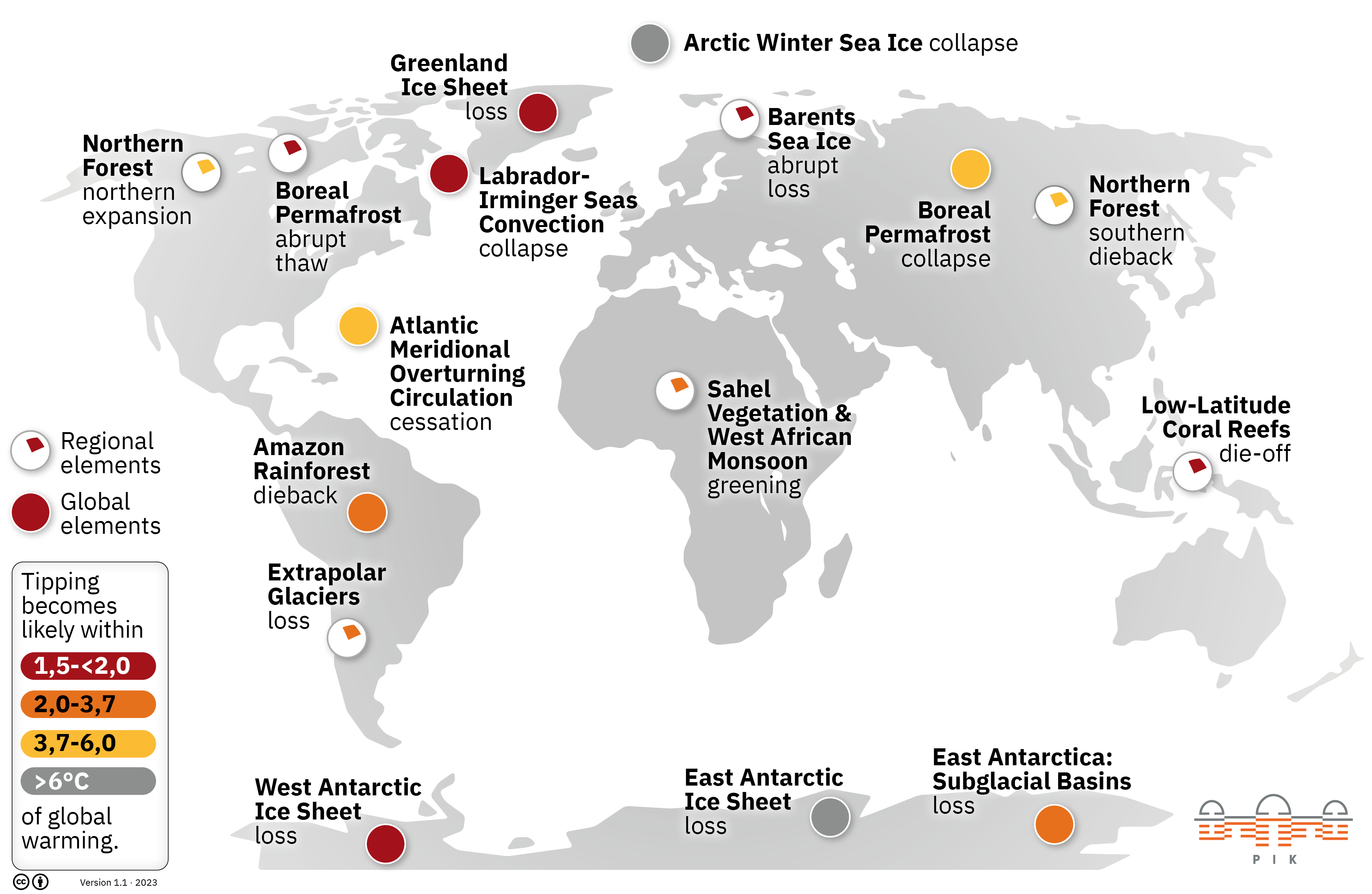
Tipping points are critical limits in human pressures–such as greenhouse gas emissions, deforestation, pollution–beyond which small changes can trigger large, potentially abrupt and hard to reverse shifts in components of the Earth system.
The science brief reviews the current state of the science on tipping systems, including the ice sheets, ocean circulations and major biomes such as the Amazon rainforest. While uncertainties remain regarding the exact timing and thresholds of individual tipping points, the brief concludes that risks generally increase with additional global warming. The 2025 Global Tipping Points Report concluded that global warming has likely exceeded the estimated tipping-point range for tropical coral reefs, while other Earth-system components, including the Greenland Ice Sheet and the Amazon rainforest, may face tipping-point risks below 2°C of warming.
A central message of the report is that tipping-point risks differ from many environmental risks usually addressed by international governance frameworks. According to the brief, tipping-point risks require governance approaches that can anticipate long-term change and account for interactions across different parts of the Earth system.
The publication follows a speech by UN Secretary-General António Guterres at London Climate Action Week on June 23, in which he warns of risks including coral reef loss, melting ice sheets and rising sea levels.
The science brief is part of the work of the UN Secretary-General’s Scientific Advisory Board, which provides independent scientific advice on issues of global concern.
Link to science brief:
https://www.un.org/scientific-advisory-board/en/earth-system-tipping-points-
Contact:
PIK press office
Phone: +49 331 288 25 07
Email: press@pik-potsdam.de
Web: https://www.pik-potsdam.de/en
Social media: https://www.pik-potsdam.de/socials