

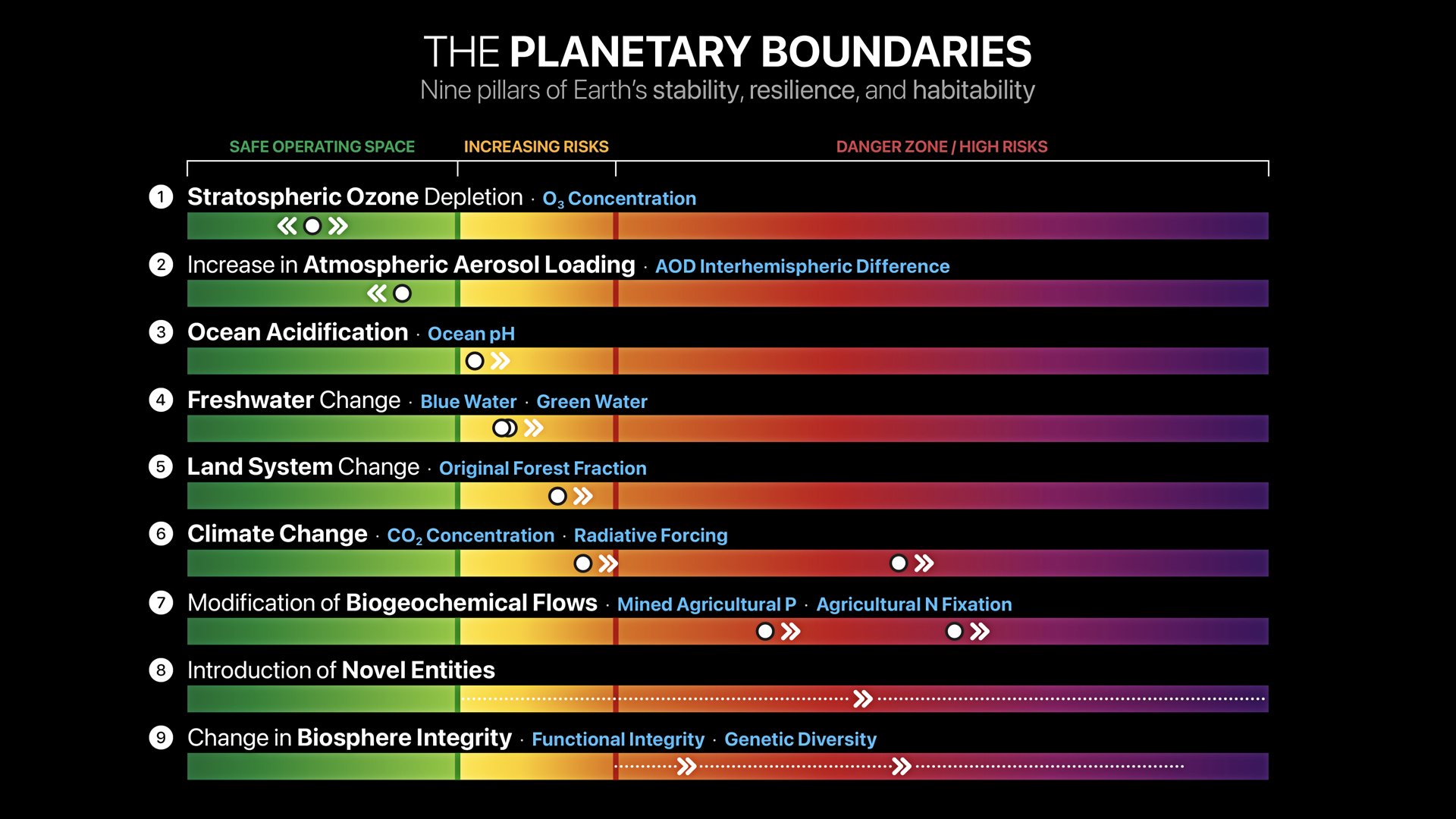
The Planetary Boundaries describe the interconnected Earth-system processes that must remain within safe limits to preserve the planet’s stability and resilience. Seven of the nine Planetary Boundaries are now transgressed, with ocean acidification the latest to breach its boundary in 2025. All seven are now at their highest recorded levels of transgression.
The seven transgressed boundaries are: climate change, change in biosphere integrity, land system change, freshwater change, modification of biogeochemical flows, introduction of novel entities, and ocean acidification. Only the stratospheric ozone depletion and atmospheric aerosol loading boundaries have shown improvement over the last decade. However, the authors caution that global progress may mask unsafe aerosol levels persisting in some regions.
“The diagnosis is unambiguous. Pressure is rising across every Planetary Boundary already outside the safe operating space. It means that the risk of large-scale, persistent and potentially irreversible change is increasing, while our margin for error in tackling these problems is shrinking,” commented Boris Sakschewski, lead author of the report.
“We do not have the luxury of time, but we do have the knowledge, capacity and solutions to change course. Accelerating action to return to the safe operating space across all Planetary Boundaries is essential to protect lives and livelihoods, and to deliver on the promise of shared future prosperity,” said Johan Rockström, PIK Director and co-author of the report.
A year of extreme events highlights escalating risks
The report comes after 12 months marked by extremes across land and oceans. Human-caused warming intensified several major weather extremes, while degraded ecosystems, water stress, land-use change, exposure and social vulnerability often magnified their impacts.
Pakistan’s 2025 monsoon floods affected more than 6.9 million people. Global ocean heat content reached a new record in 2025, with Hurricane Melissa rapidly ramping up to a Category 5 Hurricane and striking Jamaica after passing over exceptionally warm seas. From January 2023 to September 2025, bleaching-level heat stress impacted about 84.4 percent of the world’s coral reef area, making it the largest global coral-bleaching event observed to date.
In 2026, Western Europe experienced its hottest June-July period on record, accompanied by drought across France, Spain, Germany and the United Kingdom, with major wildfires across Europe and Canada. Record-breaking heat was also recorded in Japan, South Korea and parts of the Middle East.
Hindou Oumarou Ibrahim, Chair of Planetary Guardians, said, "Read that list again: Pakistan, the Caribbean, Europe, the reefs beneath our oceans. These are not separate emergencies; the planet is telling us, in every region at once, that it is out of balance. As Chair of Planetary Guardians, I hear this same story wherever I go, whether from a pastoralist watching the rains fail season after season or a coastal community watching the sea rise. The 2026 Planetary Health Check puts data behind what communities on the frontlines already know from living it. We do not have the luxury of treating these as separate crises any longer.”
Natural carbon sinks under pressure
“Any kind of movement requires patience, trust, and the will to keep going, even when it may be easier to stop. The 2026 Planetary Health Check tells us we need that same collective resolve now, applied to the whole planet. Seven of nine boundaries are broken, and no single nation can restore them alone; this is a peace process the entire world must commit to, together, starting now,” said former President of Colombia and Co-Vice Chair of the Planetary Guardians, President Juan Manuel Santos.
Vegetation and soils absorb a substantial share of human carbon dioxide emissions, but repeated heat, drought, fire and ecosystem degradation can reduce carbon uptake and, in some regions, turn ecosystems from sinks into carbon sources. This year’s report discusses whether the models that we use to calculate the land carbon sink may overestimate its resilience.
“Our path to net zero emissions relies on functioning carbon sinks. Current observations raise the alarm that our planet may be losing its buffering capacity against the increasing pressures we’re putting on it,” Sakschewski said.
Report:
Planetary Boundaries Science (PBScience), 2026: Planetary Health Check 2026. Potsdam Institute for Climate Impact Research, Potsdam, Germany.
The Planetary Guardians:
The Planetary Guardians are a collective of committed leaders. They have come together to secure a safe, just, and healthy future where humanity and the planet flourish together. Their mission is to elevate the science to make the Planetary Boundaries a measurement and operating framework for the world.
Contact:
PIK press office
Phone: +49 331 288 2507
E-Mail: press@pik-potsdam.de
Web: www.pik-potsdam.de/en
Social Media: www.pik-potsdam.de/socials