

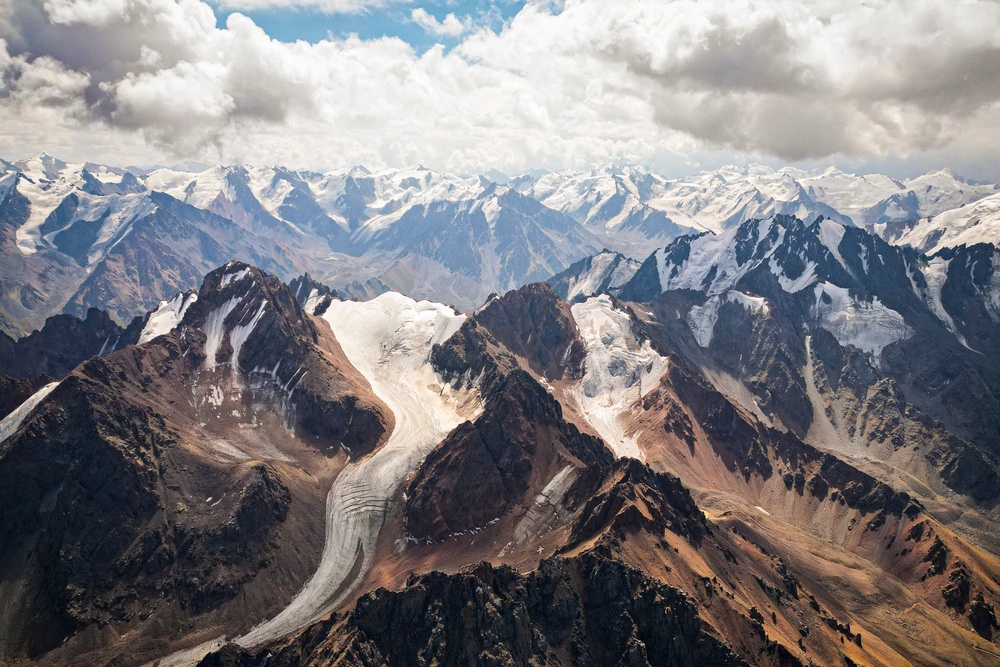
“The overall picture is of a region in rapid transition,” summarises PIK researcher Iulii Didovets, who coordinated the project as lead editor. “Central Asia is warming faster than the global average, causing its glaciers to lose up to 85 percent of their volume by 2100. Our book shows climate change to be a risk multiplier for social tensions. However, shared water and climate challenges can also open new avenues for cooperation between the five countries.”
Co-edited by Valentina Krysanova and Fred Hattermann (PIK) and Abror Gafurov (GFZ Helmholtz Centre for Geosciences), the book is the first to assess climate change and its impacts across all five Central Asian countries, totalling approximately 75 million inhabitants, and across sectors. It draws on the framework of the international climate modelling initiative CMIP6 and covers climate trends and projections, the cryosphere and mountain hazards, water resources, agriculture and the water–energy–food nexus, health, protest and peacebuilding. Each chapter summarises the current state of knowledge and identifies gaps where more research and funding are needed.
Sharpening competition between water demands
Overall, there appears to be a latent threat to the well-being of the inhabitants of these five countries. Currently, glacier-fed rivers are receiving additional meltwater, temporarily augmenting water availability. However, this relative abundance will likely be followed by rapid decline and devastating shortage. In the Tian Shan mountain range further north, this glacier depletion will occur much sooner than in the Pamir range to the south.
By 2050, depending on the scenario, river water volumes during the period July to September is expected to decline by up to 50 percent. This hits the growing season when water is needed the most, chiefly to supply irrigated agriculture which accounts for up to 92 percent of water withdrawals in some countries. At the same time, upstream regions rely on hydropower for most of their electricity, so shifting river flows will sharpen competition between the demands of irrigation, energy production and transboundary water sharing.
Book reference:
Editors Didovets, I., Krysanova, V., Hattermann, F., Gafurov, A., (2026): Towards Sustainable Future of Central Asia: Analysis of Climate, Resources and Human Security. – Springer Nature. [DOI: 10.1007/978-3-032-29989-5, ISBN 978-3-032-29988-8 (Print Hardcover) / 978-3-032-29991-8 (MyCopy Softcover) / 978-3-032-29989-5 (eBook)]
Link to free download:
Contact:
PIK press office
Phone: +49 331 288 2507
E-Mail: press@pik-potsdam.de
Web: https://www.pik-potsdam.de/en
Social Media: https://www.pik-potsdam.de/socials