

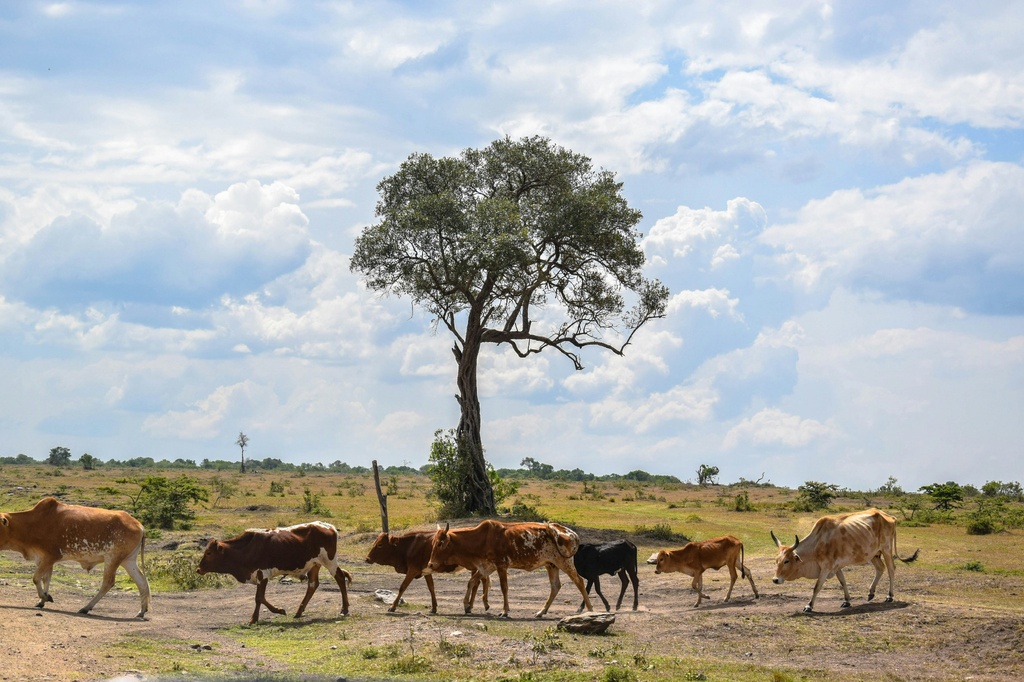
The study, published in the scientific journal PNAS today, identifies a ‘safe climatic space’ for cattle, sheep and goat grazing. To date, these agricultural systems have thrived within certain ranges of temperature (from −3 to 29°C), rainfall (between 50 and 2627 millimetres per year), humidity (from 39 to 67 percent) and wind speeds (between 1 and 6 metres per second).
“Climate change will shift and significantly contract these spaces globally, leaving fewer spaces for animals to graze. Importantly much of these changes will be felt in countries that already experience hunger, economic and political instability, and higher levels of gender inequity,” commented lead author Chaohui Li, PIK researcher at the time the study was conducted and now with the Barcelona Supercomputing Center.
“Grassland-based grazing is highly dependent on the environment, including things like temperature, humidity, and water availability. What we see is that climate change is going to reduce the spaces in which grazing can thrive, fundamentally challenging farming practices that have existed for centuries,” commented Maximilian Kotz, another of the study’s coauthors and researcher at the Barcelona Supercomputing Center and PIK.
Africa a hotspot for impacts on grazing
“This shift away from what we’re identifying as the safe climatic space really challenges the efficacy of adaptation strategies that have been used in places such as Africa in times of hardship, such as switching species or migrating herds. The changes are just too big for that,” said Prajal Pradhan, assistant professor of the University of Groningen, PIK researcher and a coauthor of the study.
“Reducing emissions by rapidly moving away from fossil fuels is the best strategy we have to minimise these potentially existential damages for livestock farming,” Li concluded.
Article:
Li, C., Kotz, M., Pradhan P., Wu, X., Hu, Y., Li, Z., Chen, G., (2026): Climate change drives a decline in global grazing systems. PNAS. [DOI: 10.1073/pnas.2534015123]
Link to the article:
Contact:
PIK press office
Phone: +49 331 288 2507
E-Mail: press@pik-potsdam.de
Web: https://www.pik-potsdam.de/en
Social Media: https://www.pik-potsdam.de/socials