

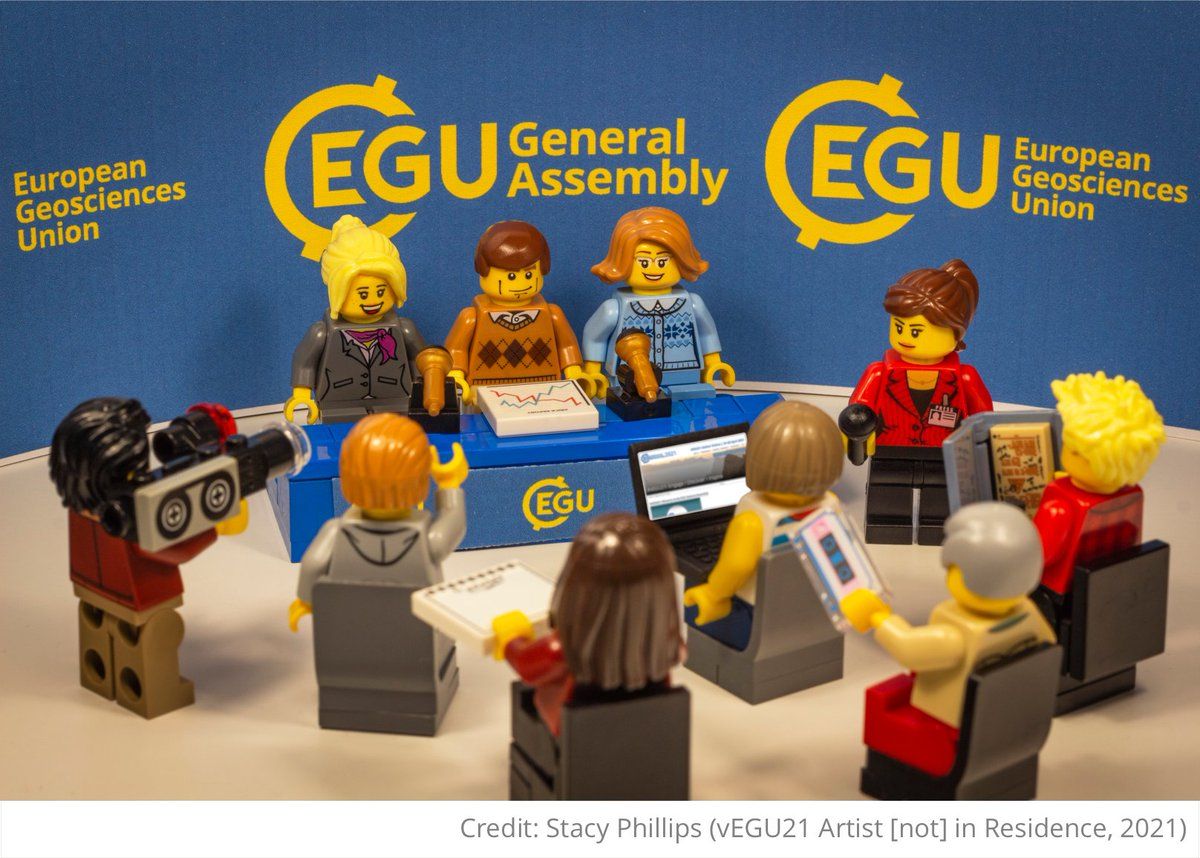
Since 22 years, the EGU organises a 'General Assembly, providing an opportunity to both early career and more senior researchers from all over the world an opportunity to present their research and discuss their ideas with experts and peers of all fields of Geoscience. Representatives of the Climate Resilience Lab 'Land Use Transition' and Working Groups 'Land Biosphere Dynamics', Hydroclimatic Risks', 'Climate Change and Health' and 'Adaptation in Agricultural Systems' contributed to the wide variety of presentations.
Paula Romanovska co-convened a session (CL3.1.3) on 'Attributing climate change, extreme events, and their impacts: quantifying contributions from external forcing, internal climate variability, and/or other drivers' with Aglaé Jézéquel, Robin Noyelle, Rupert Stuart-Smith and Sebastian Sippel. In this session, Audrey Brouillet presented her study 'Constructing DAMIP-based detrended reanalyses for event attribution: design of the ATTRICI-DAMIP dataset' and Laura Nübler presented her study on 'Event attribution of climate change impacts on child undernutrition via crop production in India'
Paula Romanovska also presented her study on 'Source attribution: From national emissions to global loss in working hours due to climate-change increased heat' during the session on 'Extremes in Geophysical Sciences: Dynamics, Thermodynamics, and Impacts'.
Sabine Undorf gave an invited talk on 'Defining events and extremes in climate change impact attribution' during a session on 'Extremes in Geophysical Sciences: Dynamics, Thermodynamics, and Impacts' and her study 'Large-ensemble climate model data for impact attribution and projections' during a Poster session.
Christoph Müller convened a session with co-conveners Elena De Petrillo, Christian Folberth, Oleksandr Mialyk and Han Su on 'Modeling agricultural systems under global change' for the seventh time in a row. In this session, Friedrich Busch presented his paper 'Integrating Farmer Motivations into Phenological Models: Impacts of Sowing Decisions on German Maize'; Jens Heinke presented his paper 'Representing persistent stress effects in LPJmL through sink limitation and tissue damage', Christoph himself gave a presentation on 'Crop-model informed economic analysis of nitrogen tax effects on food production' and Marie Hemmen presented her study on 'Canopy temperature emulation in process-based models'.
Stephen Wirth presented his study 'Functional diversity and grassland soil carbon stocks under climate change: Insights from global modelling' on a poster marked as a 'highlight'.
Tobias Conradt also presented his study 'Expected changes of river flood hazards across the Danube Basin' during a poster-session. Sebastian Ostberg presented his work with a poster on 'Implementing forest-based natural climate solutions (NCS) in a global vegetation model to better constrain global potentials'
Margaret Shanafield (Humboldt fellow co-hosted by PIK's RD2) presented her work on 'Seasonality in groundwater recharge - Observational evaluation of Earth System model realism'