

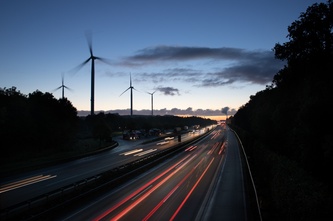
International praise for young PIK scientists
05/29/2015 - They work on carbon taxes, the German Energiewende and “flying rivers” in the Amazonian basin – the research of several young scientists from the Potsdam Institute for Climate Impact Research has recently been awarded for its excellence.
Read More
What would it take to limit climate change to 1.5°C?
05/21/2015 - A new study analyzes the required climate policy actions and targets in order to limit future global temperature rise to less than 1.5 degrees Celsius by 2100. This level is supported by more than 100 countries worldwide, including those most vulnerable to climate change, as a safer goal than the currently agreed international aim of 2 degrees Celsius – an aim which would already imply substantial greenhouse-gas reductions. Hence the interest for scrutinizing the very low end of greenhouse-gas stabilization scenarios.
Read More
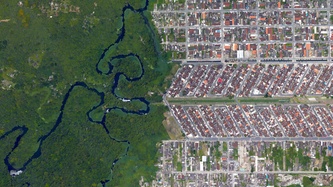
Towards a new industrial revolution: studying societies’ metabolism
05/19/2015 - To achieve a lasting transition towards sustainability, large-scale conversion of our built environment – cities, transport systems, power generation – is key. This is an outcome of a special feature investigating advances in the research on industrial ecology, published in the Proceedings of the US National Academy of Sciences (PNAS) and coordinated by the Potsdam Institute for Climate Impact Research (PIK). Studies cover topics from the urbanization effects to the material basis of modern societies, fundamental research that informs decision-makers.
Read More
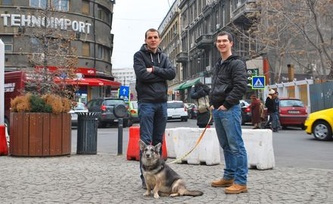
Urban interventions: new artists in residence
05/07/2015 - Two Romanian architects are this May’s artists in residence at the Potsdam Institute for Climate Impact Research (PIK). Alex Axinte and Cristi Borcan, known as studioBASAR, will be exchanging views with researchers who explore climate change impacts on cities – a topic which various projects at the institute focus on. Starting this year, the City of Potsdam joins the team of partners organizing the programme, alongside the Artists’ Programme of the German Academic Exchange Service DAAD and PIK.
Read More

New junior professor for climate adaptation
05/05/2015 – To strengthen its research on climate adaptation, the Potsdam Institute for Climate Impact Research (PIK) has chosen Nicole Glanemann to become a junior professor in this crucial field. The joint appointment by the Otto Beisheim School of Management WHU and PIK focuses on the impacts of climate change on global infrastructures and supply chains. The new professorship is also intended to advance the economic theory of adaptation and mitigation.
Read More
Tackling climate change adaptation: European conference in Copenhagen
04/30/2015 - Decision-makers from politics, business and science will meet from May 12-14 in Copenhagen to discuss climate change adaptation. Organized on behalf of the European Commission by three major climate adaptation projects, the European Climate Change Adaptation Conference ECCA 2015 will bring together scientific and practical knowledge to explore strategies for European cities to cope with climate impacts. The Potsdam-Institute for Climate Impact Research, being the leader of one of the featured EU projects, is a co-organizer.
Read More
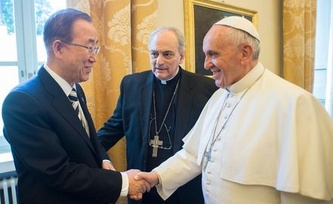
„A moral imperative“: Schellnhuber speaks at Vatican climate meeting
04/29/2015 - In the run-up of the much anticipated encyclica on climate change by Pope Francis, the Pontifical Academy of Sciences hosted a workshop with researchers as well as religious, business and civil society leaders this week. The list of distinguished speakers in the Vatican included UN Secretary General Ban Ki Moon, the Nobel Laureates Yuan Tseh Lee and Paul Crutzen, Veerabhadran Ramanathan of the Scripps Institution of Oceanography/University of California, the economist Jeffrey Sachs of New York's Columbia University, and John Schellnhuber, director of the Potsdam Institute for Climate Impact Research. The goal was, according to the organizers, to build a global movement to deal with climate change and sustainable development throughout 2015 and beyond.
Read More

Girls' Day: students learn about career opportunities in science
04/24/2015 - Students from Berlin and Brandenburg visited the Potsdam Institute for Climate Impact Research on “Girls’ Day”. The day offers opportunities for young girls to find out about professions in the natural sciences, skilled crafts and trades, technology and information technologies and learn about alternative career opportunities.
Read More

“Developing our cities, preserving our planet”: Nobel Laureates gather for the first time in Asia
23.04.2015 - Nobel Laureates across the world and across disciplines this week are gathering in Hong Kong to elevate the debate on climate change to a new level and to feed into the world climate summit in Paris later this year. For the first time, the Nobel Laureates are meeting in Asia for the symposium, “4C: Changing Climate, Changing Cities”. Cities are key to addressing the challenge of climate change which, if unabated, might result in a 4°C rise in mean temperature by the end of this century. Participants of the symposium include Nobel Prize winners Yuan T. Lee (Chemistry, 1986) from Taiwan, Brian Schmidt (Physics, 2011) from Australia, and James A. Mirrlees from the United Kingdom (Economics, 2006), complemented by international renowned experts such as K.S. Wong, Secretary for the Environment, The Government of the Hong Kong Special Administrative Region, and Aromar Revi of the Indian Institute for Human Settlements.
Read More
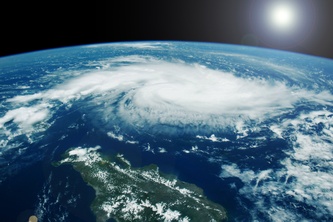
Earth Day: Leading climate scientists publish essential elements for a global climate agreement
04/22/2015 - The Earth League, an international alliance of prominent climate scientists, outlined the elements of a global climate agreement in a stark statement published today, coinciding with Earth Day. Written by 17 world-leading scientists, among them PIK director Hans Joachim Schellnhuber, their statement clarifies in eight essential elements, what an international climate agreement in line with the 2 degree target should achieve in Paris in December. Bold action by decision-makers is required now to pave the way for a successful international agreement to reduce the risk of dangerous climate change, the Earth League members say.
Read More