
Major risk assessment links climate change with Germany’s national security
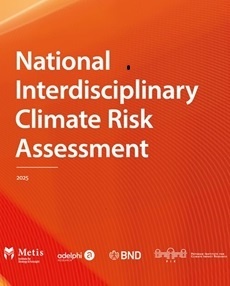
The GeoClimRisk project originates in connection with a related initiative under Germany’s National Security Strategy 2023. Under the Strategy, leading science organisations in-country were tasked with developing a National Interdisciplinaray Climate Risk Assessment (NIKE), which – for the first time – comprehensively assesses the many inter-linked strategic and security risks, both direct and indirect, for Germany arising with climate change and the energy transition. The Assessment was co-authored by GeoClimRisk Project Lead, Fanny Thornton, and was launched at events with Federal Foreign Office State Secretary, Jennifer Morgan, as well as at the Munich Security Conference in February 2025. GeoClimRisk picks up on the Assessment by extending the lens of climate change-related risks and strategic foresight to work with partners in other country contexts.
https://metis.unibw.de/assets/pdf/National_Interdisciplinary_Climate_Risk_Assessment.pdf (pdf)
Assessment-Website: https://metis.unibw.de/de/nike/
https://www.politico.eu/article/climate-change-eu-germany-bnd-report-security-global-warming/
Press release by the Federal Foreign Office: https://www.auswaertiges-amt.de/en/newsroom/news/2700056-2700056
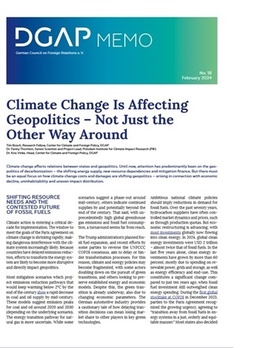
DGAP MEMO: Climate Change is Affecting Geopolitics – Not Just the Other Way Around
Together with its project partner, the Center for Foreign Policy (DGAP), the GeoClimRisk project aimed to provide a more comprehensive overview of the factors driving geopolitical shifts.
Until now, the focus has primarily been on the geopolitics of decarbonization—changing energy supplies, new resource dependencies, and mitigation finance. However, equal attention must be given to how the costs and damages of climate change are reshaping geopolitics, particularly through economic decline, uninhabitability, and the uneven distribution of impacts.
A Climate Double-Crunch? Implications for Development and Security in India
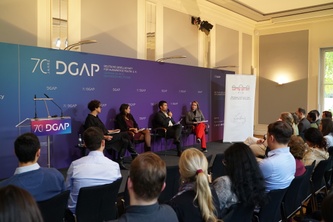
The side event “A Climate Double-Crunch? Implications for Development and Security in India”, held on October 22, 2025, in Berlin as part of the Berlin Climate and Security Conference, was met with great success. Jointly organized by the German Council on Foreign Relations (DGAP) and the Potsdam Institute for Climate Impact Research (PIK) under the GeoClimRisk project, the session explored how India is navigating the double crunch of managing the accelerating impacts of climate change while advancing sustainable development and an energy transition.
Fanny Thornton, Project Lead of GeoClimRisk project at PIK, moderated the lively and thought-provoking exchange among an expert panel. The panel featured Utkarsh Patel, Climate Science and Policy Researcher at the Centre for Social and Economic Progress (CSEP), India; Dr. Abdullah Fahimi, Research Fellow at the German Council on Foreign Relations (DGAP); Frauke Roeser, Climate Policy Analyst at NewClimate Institute; and Anne-Mareike Vanselow, Acting Head of the Division for Climate Partnerships, Bilateral Climate Cooperation, and the International Climate Initiative (IKI) at the German Federal Foreign Office (AA).
Their discussion built upon a scientific input by Dr. Nicolas Bauer and Anna Reckwitz from the Potsdam Institute for Climate Impact Research (PIK), highlighted how overlapping climate and development pressures can reinforce one another, shaping both risks and opportunities for emerging economies such as India.
Throughout the session, the panelists examined India’s complex position as a rapidly developing economy that is simultaneously exposed to mounting climate-related stresses. They discussed the implications for development planning, infrastructure resilience, and security, emphasizing the importance of integrated policy approaches that connect climate adaptation, sustainable growth, and regional stability.
The event underscored that the “climate double crunch” is not only an Indian challenge but a global one, demanding stronger cooperation between science, policy, and practice. Participants agreed that India’s experience offers valuable lessons for other emerging economies seeking to balance development ambitions with climate resilience.
By linking scientific insight with policy dialogue, the session demonstrated the importance of evidence-based approaches to climate security and highlighted the crucial role of interdisciplinary collaboration in addressing one of the defining challenges of our time.
The Resilience Brief Episode 4: Disaster Mode – Activated
GeoClimRisk Project Lead Dr. Fanny Thornton recently joined The Resilience Brief podcast to discuss the growing impact of climate change on defence and global security.
NATO armed forces not only face the demands of modern conflict but also the increasing need to strengthen resilience against climate-related risks. However, financial pressures often prioritize short-term disaster response over long-term climate adaptation, leaving critical gaps in organisational resilience and underestimating enduring threats such as desertification.
In conversation with Dr. Duraid Jalili (King’s College London), Dr. Thornton explores how climate-related disasters intensify global instability and the vulnerabilities that arise when armed forces are not adequately prepared. The discussion highlights the importance of integrating scientific and industrial knowledge into Defence planning to better anticipate future risks.
Hosted by Dr. Sarah Ashbridge and Lt. Col. Ali Beard, this episode offers an in-depth look at why understanding climate impacts is essential for defence readiness and long-term security planning.
Listen to Episode 4 also available on Spotify and Apple Music
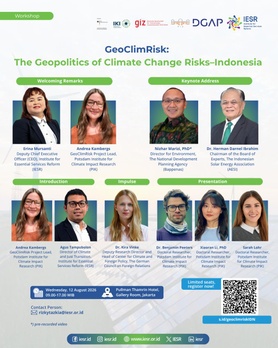
GeoClimRisk Closing Workshop in Jakarta
The GeoClimRisk Closing Workshop in Jakarta marked an important milestone for the project. Hosted by our Indonesian project partner, the Institute for Essential Services Reform (IESR), and jointly organized with the Deutsche Gesellschaft für Internationale Zusammenarbeit (GIZ), the German Council on Foreign Relations (DGAP), and the Potsdam Institute for Climate Impact Research (PIK), the workshop brought together project partners and experts to discuss the project’s key findings, with a particular focus on the Indonesian geopolitical context.
Presentations of the research findings provided the foundation for an intensive exchange in a series of breakout sessions. These deep-dive discussions gave participants the opportunity to reflect on the findings, examine them from different perspectives, and connect research insights with practical and policy considerations.
The workshop once again highlighted the importance of interdisciplinary and international collaboration in addressing the complex interlinkages between climate change, energy policy, economic development, and migration. The open and constructive discussions in Jakarta provided valuable perspectives on how research can inform policy debates and contribute to a deeper understanding of these interconnected challenges.
We would like to sincerely thank IESR for being an excellent host, as well as all participants, project partners, and supporters whose expertise, perspectives, and commitment contributed to making the workshop a success.
We thank everyone involved for a successful closing workshop and for the inspiring exchange in Jakarta.
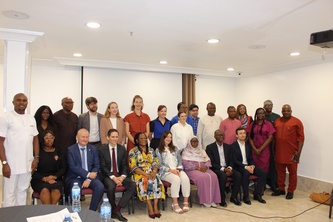
GeoClimRisk Closing Workshop in Abuja
The GeoClimRisk project concluded with a closing workshop in Abuja, bringing together researchers, policymakers, development partners and other key stakeholders to reflect on the project’s findings and discuss their implications for Nigeria’s climate and development agenda. he workshop provided an opportunity to present the project’s key scientific results and explore how these findings can inform evidence-based climate policy and decision-making in Nigeria. Through a combination of expert presentations and interactive breakout sessions, participants examined the economic, political and social dimensions of climate change and its impacts.
Following a brief introduction to the project by project lead Andrea Kambergs (PIK), the workshop featured presentations on the project’s key scientific results, highlighting new insights into the interconnected challenges of climate change, economic development, carbon pricing, migration and conflict. Dr. Diamantis Koutsandreas (PIK) and Dr. Henry Okodua (EfD) presented research on the “Double-Cost Crunch” and explored priorities for delivering Nigeria’s Nationally Determined Contribution (NDC), with a particular focus on economic growth and climate finance. The project’s work on the political economy of climate policy was presented by Prof. Dr. Nnaemeka Chukwuone and Dr. Chizoba Oranu (EfD), together with Prof. Dr. Jan Steckel and Tessa Schiefer (PIK). Their contributions examined the opportunities and challenges surrounding carbon pricing policy and highlighted the importance of understanding political and institutional conditions when designing effective climate policies. A further focus was the climate–migration–conflict nexus. Prof. Dr. Chukwuedozie Ajaero (EfD) and Sarah Lohr (PIK) presented global insights alongside local perspectives, shedding light on the complex ways in which climate change can interact with patterns of migration, vulnerability and conflict.
The presentations were complemented by interactive breakout sessions, giving participants the opportunity to engage more deeply with the research findings, discuss their relevance to the Nigerian context and explore potential pathways for translating scientific evidence into policy and practice. The discussions underlined the importance of integrated approaches that connect climate action with economic development, social equity, and stability. They also highlighted the value of continued collaboration between scientific institutions, policymakers and development partners to strengthen the evidence base for Nigeria’s climate transition.
The closing workshop marked an important milestone for GeoClimRisk and would not have been possible without the commitment and engagement of everyone involved.

GeoClimRisk Concludes at Berlin Climate Security Conference 202
Exploring the links between climate risk, geopolitics, energy security and green growth in Nigeria, India and Indonesia
The GeoClimRisk – The Geopolitics of Climate Risk project reached a key milestone at the eighth Berlin Climate Security Conference (BCSC), held under the motto “A Climate for Security, Freedom and Prosperity.” Bringing together decision-makers and experts from around the world, BCSC 2026 provided an important platform to discuss the growing intersections between climate change, geopolitical dynamics and international security.
Since 2019, the BCSC has established itself as a leading international conference at the intersection of climate change and security. This year, the GeoClimRisk project contributed to the conference programme through a dedicated session on climate investment and security, as well as an official BCSC side event examining green transition dynamics in Nigeria, India and Indonesia.
Breakout Session at the Conference: The Double Cost Crunch: Why Climate Investments Are Essential for Security
As part of the GeoClimRisk project, a dedicated session explored the intersecting challenges of climate impacts and the economic and security implications of delayed climate action. The discussion brought together Dr. Nico Bauer, Putra Maswan, Prof. Nnaemeka Chukwuone, Utkarsh Patel and Dr. Kira Vinke, who examined the risks associated with climate change and the opportunities offered by early mitigation action in Nigeria, India and Indonesia.
The session highlighted the importance of climate investments as a strategic response to interconnected challenges. By addressing climate risks early, countries can strengthen resilience, reduce future economic costs and support long-term security and development. The discussion also underscored the need to consider the geopolitical dimensions of climate change when shaping investment priorities and policy responses.
The session convened the GeoClimRisk consortium, comprising the Potsdam Institute for Climate Impact Research (PIK), the Deutsche Gesellschaft für Internationale Zusammenarbeit (GIZ), the German Council on Foreign Relations (DGAP), the Institute for Essential Services Reform (IESR), the Centre for Social and Economic Progress (CSEP), and the Resource and Environmental Policy Research Center at the University of Nigeria, within the Environment for Development [EfD) initiative.
GeoClimRisk Side Event: Financing the Green Transition: Policy Instruments, Energy Security, and Geopolitical Dimensions. Perspectives from Nigeria, Indonesia, and India.
At an official BCSC side event, GeoClimRisk further explored the policy and financial instruments shaping green transitions in Nigeria, India and Indonesia. The roundtable, moderated by Tim Bosch, Research Fellow at the DGAP, provided an opportunity for an in-depth exchange on how domestic policy priorities and changing geopolitical conditions are influencing the three countries’ pathways towards a greener economy.
The discussion highlighted how recent fossil fuel energy crises and shifting geopolitical dynamics have reinforced the strategic importance of the green transition. At the same time, domestic priorities are playing a crucial role in advancing climate action, with governments seeking to combine emissions reductions with economic growth, energy security and sustainable development.
Contributions from Tessa Schiefer, Putra Maswan, Soumya Chaturvedi and Prof. Nnaemeka Chukwuone offered valuable research and policy perspectives on these developments. The exchange demonstrated that green transitions are shaped not only by climate commitments but also by national economic interests, energy vulnerabilities and broader geopolitical considerations.
As countries navigate volatile energy markets and evolving international partnerships, effective policy frameworks and targeted financial instruments will be essential to accelerate decarbonisation while supporting economic and social development.
Strengthening the Climate–Security Nexus
GeoClimRisk’s contributions to BCSC 2026 reinforced the importance of understanding climate risks through a geopolitical lens. The project’s discussions demonstrated that early climate investments and green transition strategies can play a vital role in addressing the interconnected challenges of climate change, energy security and economic resilience.
By bringing together research institutions, policy experts and international partners, GeoClimRisk continues to advance a comparative understanding of how Nigeria, India and Indonesia are responding to climate-related risks and navigating the opportunities and challenges of the green transition.
Check out DGAP’s LinkedIn post on the conference:https://lnkd.in/p/dbiX9Mti