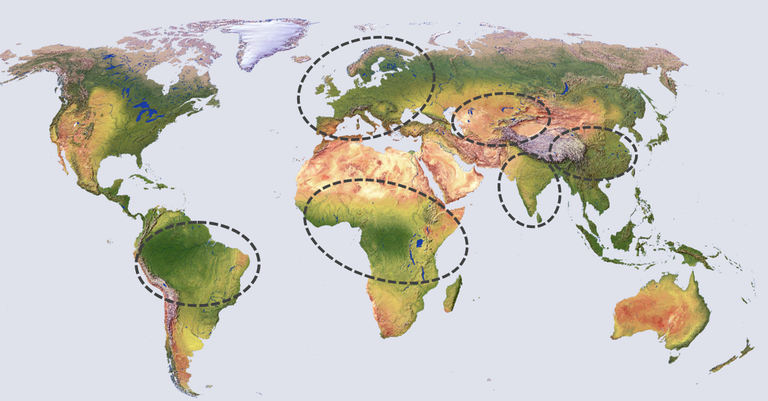
PIK conducts studies in many regions around the world, from Germany to far beyond Europe. Our work is strongest when we bring together complex models with on-the-ground evidence. This approach helps us understand both global patterns and local realities. We learn from case studies in Europe while also collaborating closely with partners in Africa, Asia, and Latin America, where many countries are particularly vulnerable to climate impacts and urgently need solutions for adaptation, mitigation, and climate resilience.
Our research involves cross-sectoral and multi-scale assessments of regional climate risks and adaptation strategies. We integrate methods from hydrology, land-use, agricultural and forest sciences, public health, and economics. Systematic and comparative case studies feed into innovative climate services. By transferring this knowledge to regional decision-makers, we support the implementation of global frameworks such as the three Rio Conventions (UNFCCC, UNCCD, CBD) and the UN Sustainable Development Goals (SDGs).
Our platform climateimpactsonline supports decision-makers in assessing the impacts of climate change in their respective world regions.
Climate change is already evident in Europe, with temperatures rising faster than the global average, changing rainfall patterns, and a more intense hydrological cycle. In many regions, for example, groundwater and soil moisture are declining, while vegetation zones and growing seasons are shifting. These changes call for a range of adaptation and mitigation strategies to enable climate neutral and risk resilient development. To achieve this, it is essential to assess climate related risks and the economic costs of their impacts. These assessments go hand in hand with modeling decarbonisation pathways and developing cross border management approaches for forests, agriculture, and water resources.
As in other parts of Europe, the impacts of climate change are clearly visible in Germany. Average temperatures have risen by about 2°C since the late 19th century, and the country is experiencing longer dry periods followed by episodes of heavy rainfall. In some parts of eastern Germany, the first half of 2025 was the driest since meteorological records began 130 years ago. Conversely, the flooding in the Ahr Valley in 2021 was one of the most devastating ever recorded. Prolonged droughts, together with storms and severe insect outbreaks, have caused significant forest loss. Another major challenge in eastern Germany is the phase-out of lignite mining and its consequences.
Sub‑Saharan Africa faces a complex set of challenges in the context of climate change. Rapid population growth, rising demand for natural resources, and emerging conflicts must be managed sustainably to secure a stable future. Ensuring reliable access to food, water, and energy is key to building a resilient development pathway. The region is already experiencing the effects of climate change, including higher temperatures, shifting rainfall patterns, and more frequent extreme weather events. These changes threaten food security and the livelihoods of millions. Compounding factors such as resource depletion and social tensions further amplify vulnerabilities. To foster stability and prosperity, targeted investments in climate‑resilient agriculture, renewable energy, and water management are essential.
Central Asia, comprising Kazakhstan, the Kyrgyz Republic, Tajikistan, Turkmenistan, and Uzbekistan, is a region of high diversity, with extensive deserts, wide steppes, and high mountain ranges. Yet, this rich natural environment is increasingly under pressure from climate change, which amplifies existing environmental and socio‑economic challenges. Changing hydrological patterns have reduced the already limited availability of freshwater. This shortage directly affects agriculture, a cornerstone of Central Asian economies, leading to lower crop yields and increasing risks to food security. The consequences extend well beyond the environment. Competition for scarce resources is intensifying, raising the potential for regional tensions and conflict. As rural livelihoods become less viable, many people migrate to cities or abroad in search of better opportunities. This trend places additional strain on urban infrastructure and social services and can increase economic dependence on foreign partners.
South Asia, home to a large and growing population, is particularly vulnerable to the effects of climate change. More frequent extreme weather events, shifting monsoon patterns, and rising temperatures are placing significant pressure on agriculture, infrastructure, and ecosystems. Robust scientific evidence on these impacts, along with effective adaptation and sustainable transition strategies, can guide better decisions and investments. This knowledge supports governments, the private sector, academia, and civil society in strengthening resilience across the region.
China faces a wide range of climate challenges shaped by its vast geographic diversity—from drought‑prone northern plains and rapidly urbanizing coastal zones vulnerable to sea‑level rise, to the fragile ecosystems of the Tibetan Plateau. Intensifying floods, heatwaves, and water scarcity increasingly threaten agriculture, energy production, and urban development. As one of the world’s most populous nations and a major emitter of greenhouse gases, China plays a crucial role in global climate mitigation and adaptation efforts. Networks of Chinese field trials and data bases enable scientific research on agricultural productivity, land use, biodiversity, and decarbonization pathways that provides valuable insights into regional vulnerabilities and trade‑offs between food production, climate action, and environmental protection. Such evidence‑based assessments are key to guiding sustainable and resilient long‑term development.
Disruptive weather events such as El Niño can severely affect food and water security, undermining the foundations of resilient development at national, regional, and local scales. At the same time, agricultural expansion and land‑use change are driving deforestation, biodiversity loss, and greenhouse gas emissions, adding further stress to the environment. To strengthen resilience against climate variability, cross‑sectoral planning based on seasonal climate forecasts is essential. Such integrated approaches help align adaptation and mitigation measures, supporting sustainable development and long‑term stability across the region.