

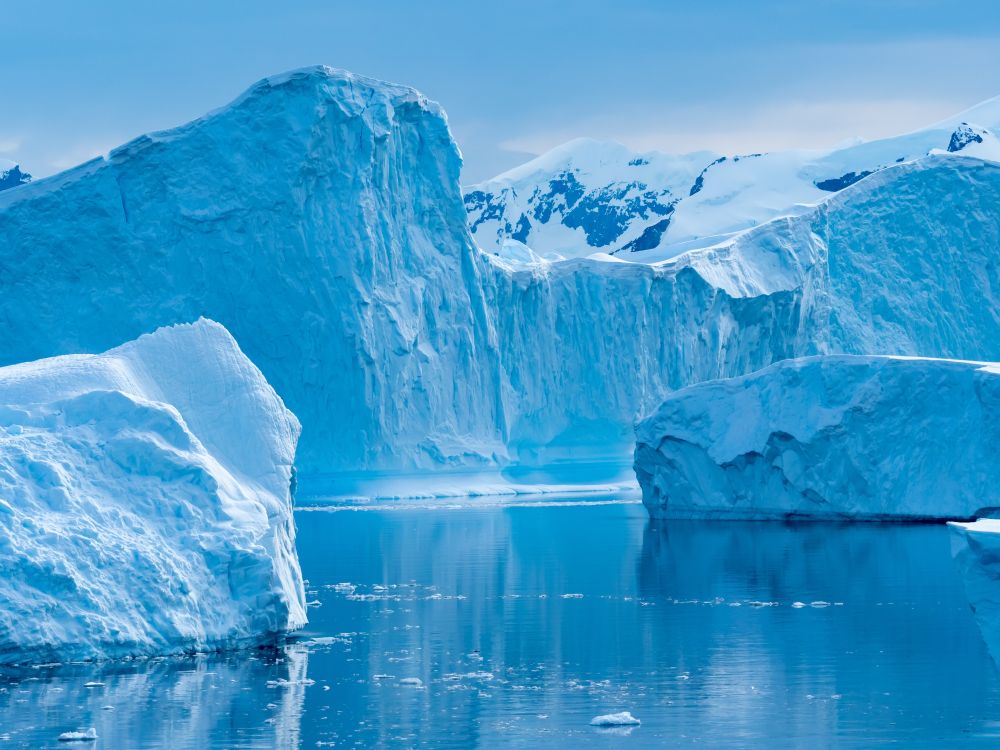
“It’s not one single threshold we need to watch in Antarctica – it’s a sequence”, explains Ricarda Winkelmann, MPI-GEA director, PIK scientist and lead author of the study published in Nature Climate Change. “In fact, we find that ice loss in some Antarctic basins unfolds gradually with warming, whereas other basins are characterised by a tipping point, beyond which the loss of ice accelerates disproportionally to the warming and can be irreversible over centuries to millennia.”
Some regions like the Amundsen Sea basin including the Thwaites and Pine Island glaciers, and the Ronne basin in West Antarctica have the lowest thresholds, and might already be past their tipping points at today’s roughly 1.3°C of global warming. “Crossing a tipping point doesn’t mean immediate collapse,” Winkelmann notes. “Large-scale ice loss in these regions unfolds over centuries, but the process may already have been set in motion in parts of the West Antarctic Ice Sheet.”
Julius Garbe, PIK scientist and co-author of the study, adds: “And it’s not just West Antarctica: in East Antarctica, the ice mass is large enough to contribute ten times more to sea-level rise than its western counterpart. Massive regions like the Wilkes Basin are also increasingly at risk of substantial ice loss with sustained warming of 2 to 5 °C above pre-industrial levels.”
Simulating 18 basins reveals interacting and cascading risks
“The Antarctic ice sheet took millions of years to form, but with global emissions continuously rising, we may lock it onto a path of long-term loss within the coming decades” states Torsten Albrecht, MPI-GEA and PIK scientist and co-author of the study.
Ricarda Winkelmann, just returning from several weeks of fieldwork in Antarctica, adds that “seeing how rapidly some regions in Antarctica are already responding to anthropogenic climate change, how extreme weather events are not only becoming more frequent but lead to subsequent changes in the ice dynamics, really puts into perspective the vulnerability of this vast ice sheet. Our mapping of potential regional tipping points shows where the greatest risks lie on the long term, and which regions of the Antarctic Ice Sheet need closest monitoring. Cutting greenhouse gas emissions rapidly is imperative to prevent further destabilisation of ice basins.”
Article:
Winkelmann, R., Garbe, J., Donges, J.F., Albrecht, T., (2026): Mapping tipping risks from Antarctic ice basins under global warming. Nature Climate Change. [DOI: 10.1038/s41558-025-02554-0]
Link to the article:
Contact:
PIK press office
Phone: +49 331 288 2507
E-Mail: press@pik-potsdam.de
Web: www.pik-potsdam.de/en
Social Media: www.pik-potsdam.de/socials