

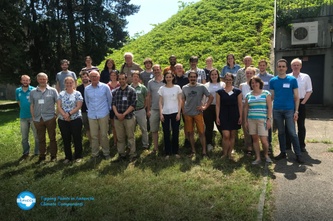
TiPACCs Annual Meeting 2022
06/14/2022 - More than 30 participants of 5 European institutions discuss latest project results
Read More
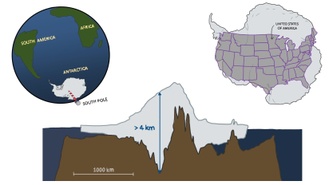
The Antarctic Ice Sheet - A Sleeping Giant?
04/27/2022 - science outreach paper for kids on the Antarctic Ice Sheet
Read More

arte documentary reseased
01/20/2022 - Ricarda Winkelmann ist starring in this arte production, discussing what would happen if there was no ice.
Read More


PISM2.0 released
12/03/2021 - New major release of the Parallel Ice Sheet Model co-developed at PIK
Read More
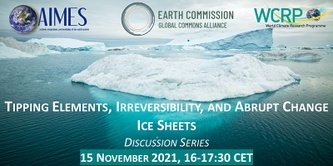
Tipping Elements Discussion Series - Ice Sheets
11/15/2021 - Continued discussion series on tipping elements, irreversibility, and abrupt change in the Earth system, introduced by Sophie Nowicki and Ricarda Winkelmann. This time: Ice Sheets.
Read More

What is it like to work as a climate scientist?
11/09/2021 - With #Mintmisson a day at PIK
Read More
New report from the Science Panel for the Amazon
09/28/2021 - The Science Panel for the Amazon (SPA) released an Executive Summary of the Amazon Assessment Report this week, a comprehensive scientific assessment of the state of the Amazon Basin. The report includes recommendations for sustainable development pathways for policy makers and governments. Over 200 renowned scientists from the Amazon and global partners, including scientists from the Potsdam Institute for Climate Impact Research, came together as the Science Panel for the Amazon to develop this report.
Read More
Tipping Elements, Irreversibility and Abrupt Change in the Earth System
09/20/2021 New discussion series on tipping elements, irreversibility, and abrupt change in the Earth system, introduced by Steven Sherwood and Ricarda Winkelmann
Read More
10.3 million euros for PIK's new high-performance cluster
08/23/2021 - A new high-performance computer cluster on Potsdam's Telegrafenberg
Read More
WE-Heraeus-Seminar on "Interacting Tipping Elements in the Natural and Social Components of the Earth System" (InTENSE)
08/18/2021 - Ice dynamics group participating in seminar hosted by DominoES project
Read More
Earth Commission General Assembly
06/18/2021 - Ice dynamics lead participates in EC meeting
Read More
Documentary "Breaking boundaries: The science of our planet" released
06/04/2021 - The movie, featuring ICE lead Ricarda Winkelmann, was launched on June 4, 2021.
Read More
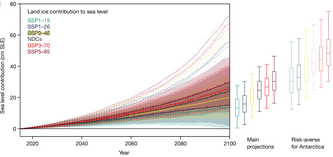
Two new studies projecting future sea-level contributions from Greenland and Antarctica
05/05/2021 - Two papers published by ice dynamics group
Read More

Members of the ice group are participating in the vEGU
04/30/2021 - Members of the ice group are participating in the vEGU
Read More
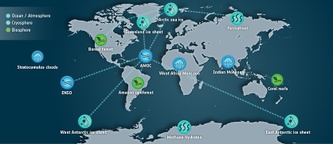
ISSI workshop on 'Tipping points in the Earth's Climate'
01/29/2021 - Important discussions on 'Tipping points in the Earth's Climate' and their monitoring via satellite observations
Read More
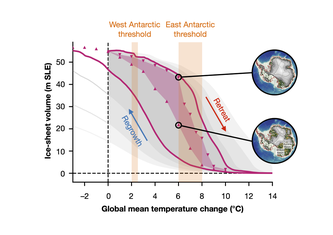
Another post in EGU's blog on Cryospheric Sciences
12/04/2020 - Julius Garbe explains why history is important when studying the dynamics of the Antarctic Ice Sheet and what hysteresis behaviour is.
Read More
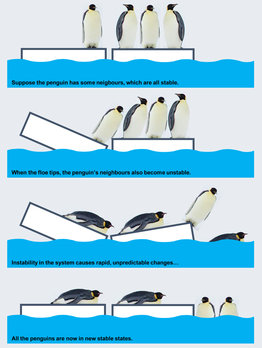
Post in EGU's blog on Cryospheric Sciences
11/13/2020 - Ronja Reese published together with Dave Chandler a post of EGU's blog on Cryospheric Sciences about tipping points in Antarctica
Read More
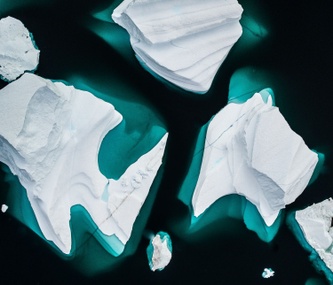
Ice loss due to warming leads to warming due to ice loss: a vicious circle
10/27/2020 - The loss of huge ice masses can contribute to the warming that is causing this loss and further risks. A new study now quantifies this feedback by exploring long-term if-then-scenarios. If the Arctic summer sea-ice were to melt completely, a scenario that is likely to become reality at least temporarily within this century with ongoing greenhouse gas emissions from burning fossil fuels, this could eventually add roughly 0.2°C to global warming. This is, however, not in addition to IPCC projections of future warming since these already take the relevant mechanisms into account. Still, the scientists could now separate the effects of the ice loss from other effects and quantify it. The 0.2°C are substantial, given that global mean temperature is currently about one degree higher than in pre-industrial times, and governments worldwide agreed to stop the increase well below two degrees.
Read More
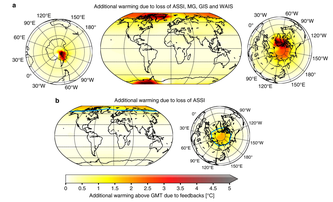
New study in Nature Communications
10/27/2020 - A new study by Nico Wunderling, Ricarda Winkelmann and others in Nature Communications
Read More
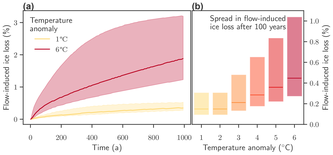
New study on the sensitivity of ice loss due to flow law parameters uncertainty
10/27/2020 - Today a new study by ice group got published in The Cryosphere
Read More
3rd #KlimaLecture hosted by Junge Akademie
10/22/2020 - Die Junge Akademie (with alumna Ricarda Winkelmann) hosted the 3rd #KlimaLecture on Digitalization and Climate Change.
Read More
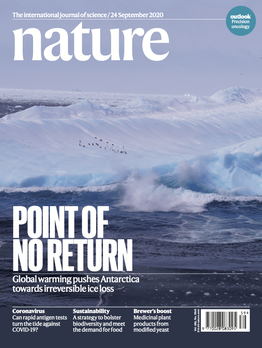
Paper "The hysteresis of the Antarctic Ice Sheet" published today and on Nature front cover
09/24/2020 - Our paper "The hysteresis of the Antarctic Ice Sheet" was published today and made it to the front cover of Nature!
Read More
Stability Check on Antarctica Reveals High Risk for Long-Term Sea-Level Rise
09/23/2020 - The warmer it gets, the faster Antarctica loses ice – and much of it will then be gone forever. Consequences for the world’s coastal cities and cultural heritage sites would be detrimental, from London to Mumbai, and from New York to Shanghai. That’s what a team of researchers from the Potsdam Institute for Climate Impact Research, Potsdam University and New York’s Columbia University has found out in their new study, published in Nature (cover story), on how much warming the Antarctic Ice Sheet can survive. In around one million hours of computation time, their unprecedentedly detailed simulations delineate where exactly and at which warming levels the ice would become unstable and eventually melt and drain into the ocean. They find a delicate concert of accelerating and moderating effects, but the main conclusion is that unmitigated climate change would have dire long-term consequences: If the global mean temperature level is sustained long enough at 4 degrees above pre-industrial levels, Antarctic melting alone could eventually raise global sea levels by more than six meters.
Read More

Greta Thunberg at PIK
08/22/2020 - ICE group leader Ricarda Winkelmann meets Greta Thunberg at PIK.
Read More