
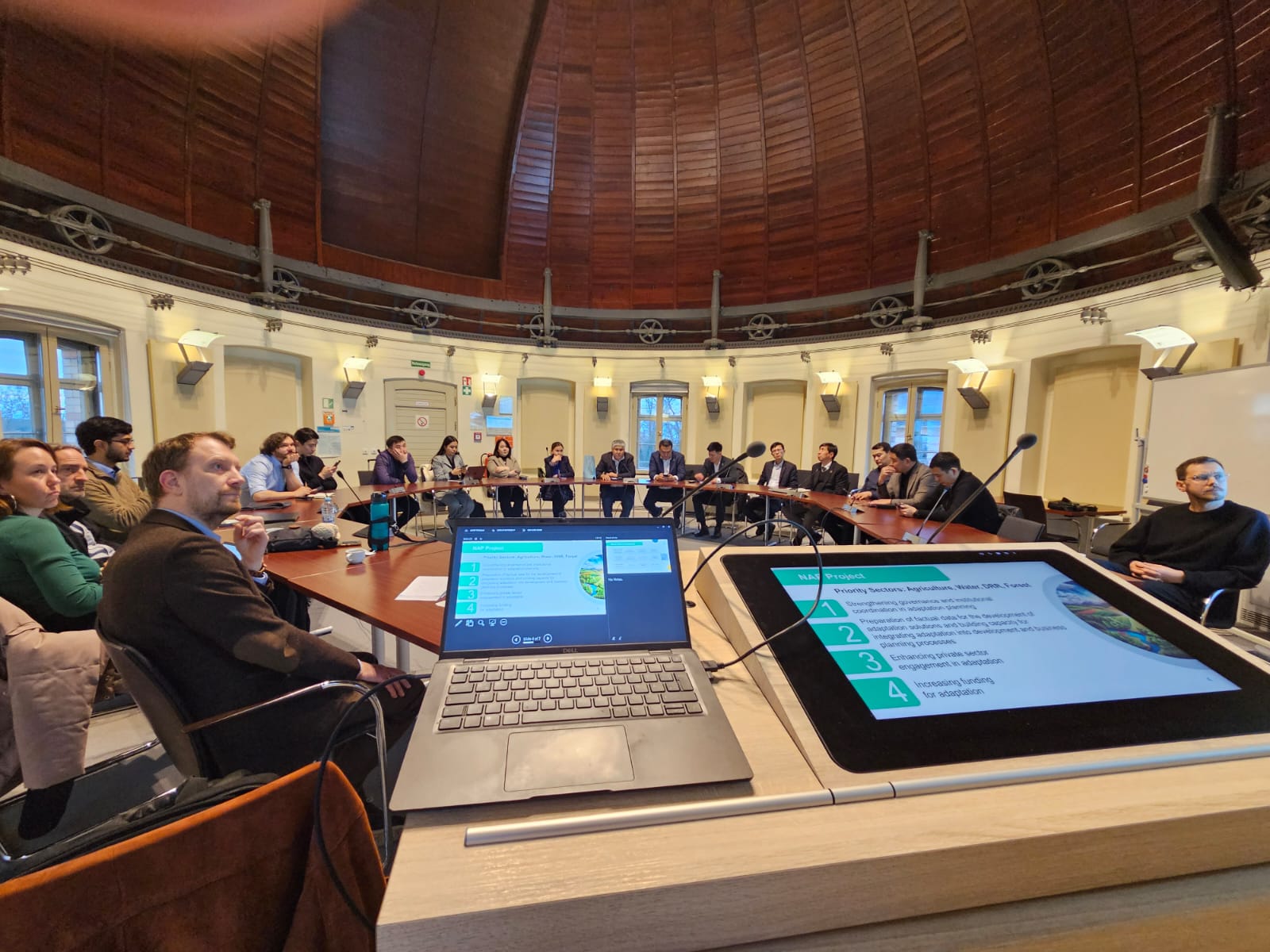
On 8 December, a delegation from Kazakhstan visited the Potsdam Institute for Climate Impact Research (PIK) in Potsdam to discuss how scientific evidence can support national climate adaptation planning. The exchange in the Big Cupola of PIKs A31 building was part of the United Nations Development Programme (UNDP) study tour Climate Change Adaptation in Germany and Lessons for Kazakhstan and was closely connected to the work of the CLIMPACT project (PIK) on climate risks and adaptation in Central Asia. The visit focused on how research institutions and public authorities can work together to develop and implement National Adaptation Plans.
After welcome remarks by Stefanie Wesch (PIK/CLIMPACT) and Saulet Sakenov (UNDP), Friedrich Busch (PIK) introduced PIKs research and capacity building activities. He outlined how the institute combines climate modelling, impact assessment and policy analysis and how it cooperates with partners worldwide to strengthen institutional capacities for climate risk assessment. In this context he also pointed to ongoing collaborations with Central Asian partners and the role of CLIMPACT (PIK) in supporting knowledge exchange in the region.
The scientific programme then highlighted concrete tools and examples that are relevant for adaptation planning in Kazakhstan. Diegopablo Pineda Schwarz (PIK/CLIMPACT) presented climate country profiles for Kazakhstan, which bring together key indicators such as temperature and precipitation trends, projections for future climate scenarios and information on climate related hazards. These profiles can help ministries and agencies to identify priority sectors and regions for adaptation measures.
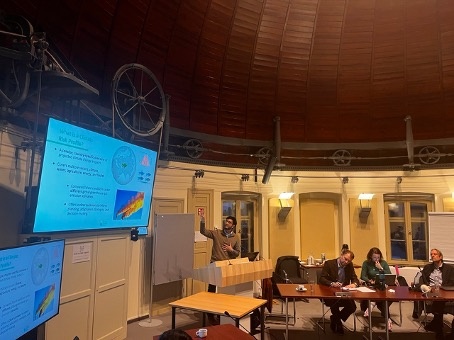
Building on this, Iulii Didovets (PIK/CLIMPACT) introduced the Climate Impacts Online platform. He showed how users can access climate projections and impact information for different regions and sectors and how such open tools can support evidence based planning beyond the scientific community. Using the mining affected Spree River basin in Germany as an example, Hagen Koch (PIK) then illustrated how regional studies can inform water management and adaptation decisions in river basins that are strongly shaped by human activities.
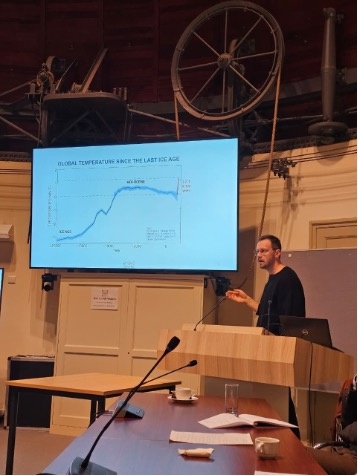
In a discussion and question and answer session moderated by Iulii Didovets (PIK/CLIMPACT), participants asked about the presented tools and their relevance for climate adaptation planning in Kazakhstan. The delegation and PIK researchers compared German based projects and initiatives in Central Asia, discussed the applicability of National Adaptation Plans in the Central Asian context and shared examples from ongoing projects in Kazakhstan. The session provided an opportunity for direct exchange between representatives of Kazakh ministries, UNDP and researchers from PIK and CLIMPACT.
The delegation included representatives from several key institutions, among them the Ministry of Water Resources and Irrigation (Kazakhstan), the Ministry of Agriculture (Kazakhstan), the Ministry of Emergency Situations (Kazakhstan), the Ministry of Ecology and Natural Resources (Kazakhstan), the Ministry of National Economy (Kazakhstan), the National Company Food Contract Corporation (Kazakhstan) and UNDP Kazakhstan. The visit contributed to CLIMPACTs (PIK) goal of strengthening science policy exchange on climate risks and adaptation in Central Asia.