

THE DAY AFTER TOMORROW - some comments on the movie
The film shows a disastrous and abrupt climate change. Due to man-made global warming, first the Larsen B ice shelf breaks up (this did happen in the real world, see animation of satellite images - allegedly only after the authors had written it into the film). This event is used to introduce the main paleo-climatologist character, Jack Hall, who is drilling out there and narrowly escapes.
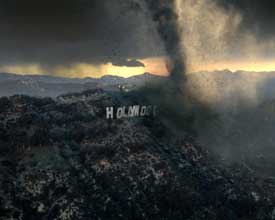
Later, in the north, meltwater inflow brings the North Atlantic Current to a halt, causing severe cooling. This happens in a matter of days. A super-storm is triggered by the oceanic shutdown. This covers much of the northern hemisphere in a few giant cyclones. It causes the flooding of Manhattan, huge hailstones in Tokyo, tornados in LA, and several days of severe snow storm covering the entire northern continents. In the eye of these super-cyclones extremely cold air is sucked down from the upper troposphere to the surface and shock-freezes the Manhattan sky-scrapers. When the super-storm clears after some days, most of the northern hemisphere is snow-covered and doomed to a new ice age due to the well-known snow-albedo feedback (i.e., the snow reflects so much sunlight that the climate stays cold).
Obviously it is easy to dismiss much of this scenario as unrealistic and exaggerated. It is – and viewers will be in no doubt that they are watching a fictional disaster movie and not a documentary. As an example: the flooding of Manhattan is described as a wind-driven surge, although this kind of massive wave (called a tsunami) could only be caused by an undersea earthquake or landslide or a meteorite hit - not by a storm or a change in the North Atlantic Current. And the shock-frosting in the eye of the storm defies the laws of thermodynamics.
The film makers are quite up-front about the fact that it's not a scientifically realistic scenario. The publicity material provided by the film company Fox says that when scientists talk about abrupt climate change they mean five or ten years, but that for dramatic reasons everything was compressed to a couple of weeks. In an interview, director Roland Emmerich also says that he is well aware that things could not happen in such a short space of time and that he knows the difference between weather and climate, but that they had to construct their own private theory to squeeze the theme into a 2-hour blockbuster movie format. To portray the dramatic effects of a major climatic disaster within a short time span, they simply took known weather extremes – tornados, storm surges, cyclones, hail storms and blizzards – and amplified those.
On the other hand, given the rules and constraints of the genre, it is remarkable to what extent the film-makers have tried to include some realistic background. Early in the film a UN climate conference in Delhi is shown where Jack Hall gives a talk about the possible risk of a shut-down of the North Atlantic Current. I gave a very similar talk at such a UN conference in Buenos Aires in 1998 - I even showed the same diagram. In the film talk, Hall states that a shutdown might occur in a hundred years, or a thousand, or not at all. Many real climatologists have said the same thing. In this way, what climatologists think is presented in a realistic way in the film, and it is very clear that the rapid drama that later unfolds is counter to what any climatologist expected - it's where the fiction starts.
The politics of climate change is also presented well. It is chillingly realistic how the head of the US delegation (the vice president in the film) responds to Hall's presentation. Thus small scenes with few sentences of dialogue are cleverly used to introduce a number of key ideas and conflicts, which are very familiar to climatologists but not to most of the people who will go and see such a movie. I also find the film quite successful in giving a flavour of the world of climate science – I did recognise our world, what the work places look like, the pictures on the wall, how the climatologists talk, etc.

After a preview of the film in Berlin I had the chance of a good talk with the script writer, Jeffrey Nachmanoff, and I was quite impressed how well-informed about the science and politics of global climate change he was.
Clearly this is a disaster movie and not a scientific documentary, the film makers have taken a lot of artistic license. But the film presents an opportunity to explain that some of the basic background is right: humans are indeed increasingly changing the climate and this is quite a dangerous experiment, including some risk of abrupt and unforeseen changes. After all - our knowledge of the climate system is still rather limited, and we will probably see some surprises as our experiment with the atmosphere unfolds. Luckily it is extremely unlikely that we will see major ocean circulation changes in the next couple of decades (I’d be just as surprised as Jack Hall if they did occur); at least most scientists think this will only become a more serious risk towards the end of the century. And the consequences would certainly not be as dramatic as the “super-storm” depicted in the movie. Nevertheless, a major change in ocean circulation is a risk with serious and partly unpredictable consequences, which we should avoid. And even without events like ocean circulation changes, climate change is serious enough to demand decisive action.
I think it would be a mistake and not do the film justice if scientists simply dismiss it as nonsense. For what it is, a blockbuster movie that has to earn back 120 M$ production cost, it is probably as good as you can get. For this type of movie for a very broad audience it is actually quite subversive and manages to slip in many thought-provoking things. I'm sure people will not confuse the film with reality, they are not stupid - they will know it is a work of fiction. But I hope that it will stir their interest for the subject, and that they might take more notice when real climate change and climate policy will be discussed in future.
More Information
For more information on the North Atlantic Current and the thermohaline circulation (of which it is a part), see the fact sheet on thermohaline circulation.
A discussion of the risk of a shut-down of this circulation is found in Shifting seas in the greenhouse? (Nature, 399, 523-524), and in The thermohaline ocean circulation - a system with dangerous thresholds? (Climatic Change, 46, 247-256).
A global warming scenario that shows such a shut-down was published in Long-term global warming scenarios computed with an efficient coupled climate model (Climatic Change, 43, 353-367). You can watch a computer animation of this scenario.
Finally, the Encyclopedia of Ocean Sciences has this discussion of Abrupt Climate Change.
Author
 |
Stefan Rahmstorf is professor of physics of the oceans at the Potsdam Institute for Climate Impact Research in Germany. For the past 15 years he has studied the thermohaline ocean circulation and its effects on climate. In 1999 Rahmstorf was awarded the $ 1 million Centennial Fellowship Award of the US-based James S. McDonnell foundation. Since 2000 he has been a member of the Abrupt Climate Change Panel of the National Oceanic and Atmospheric Administration (NOAA - the organisation for which Jack Hall works in the film). He heads the German-Norwegian project INTEGRATION which studies the possible impacts of future changes in the North Atlantic Current. |