

Influence of Mediterranean Outflow on Climate
(Article appeared in Eos, Volume 79, Number 24, June 16, 1998.)
A cover article in Eos last year [Johnson, 1997]
called for a dam across the Strait of Gibraltar to prevent a new
Ice Age. In this article, R. G. Johnson argued that reduced Nile
River flow after building the Aswan Dam increases Mediterranean
Sea salinity, leading to enhanced outflow of salty water into the
Atlantic Ocean. This in turn would alter the thermohaline (i.e.,
temperature and salinity driven) circulation of the Atlantic, heat
up the Labrador Sea and enhance evaporation there, and increase
snowfall in Canada until a new ice sheet builds up. Ocean circulation
model experiments, however, suggest that this fear is unfounded.
While Mediterranean saltwater outflow (Figure 1a) does appear to
have some effect on North Atlantic circulation and surface climate,
the change in Mediterranean salt budget resulting from the Aswan
Dam is far too small to have any noticeable impact.
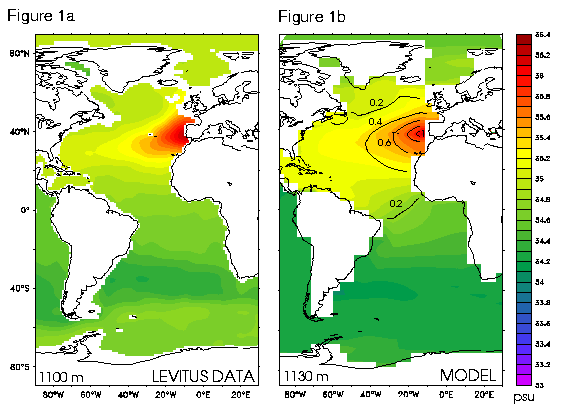 |
| Figure 1. The tongue of saline water from the Mediterranean outflow in (a) the observations of Levitus, Burgett, and Boyer [1994] and (b) the model. Contours show the salinity anomaly (practical salinity units) relative to the control experiment without Mediterranean water. |
At the heart of the argument is the sensitivity of the Atlantic
thermohaline circulation to a change in the Atlantic's net freshwater
budget. This sensitivity has been the focus of intense study during
the past ten years, and we now have a reasonable theoretical and
quantitative understanding of this sensitivity (see the review article
by Rahmstorf, et al., [1996]). A schematic stability diagram is
shown in Figure 2. It shows how the strength of the
thermohaline circulation in the Atlantic, as measured by the meridional
(north-south) volume transport, or "overturning" depends on the
net amount of freshwater entering the North Atlantic catchment.
This stability diagram is a robust result which can be obtained
with a wide variety of models, from simple box models to general
circulation models, though some uncertainty remains about the location
of the present climate in this figure.
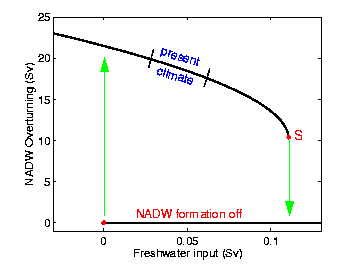 |
| Figure 2. Stability diagram for North Atlantic Deep Water (NADW) flow as function of freshwater input (precipitation and runoff minus evaporation). The location of the present climate is not exactly known, but models generally locate it in a regime where 2 equilibria, with and without NADW formation, exist. The diagram shows that increasing the freshwater input beyond S will shut down NADW flow, while restarting it requires the freshwater input to be reduced to near zero. This diagram is based on general circulation model experiments (see Rahmstorf [1996] for details). Sv = sverdrup. |
To consider the possible effect of reduced Nile flow, let us assume a worst case scenario in which the entire former Nile flow of 2,700 m3/s (0.0027 Sverdrup (Sv), 1 Sv = 106m3/s) fails to reach the Mediterranean Sea either directly or indirectly. The corresponding reduction in freshwater input into the North Atlantic catchment is too small to even mark on Figure 2. For comparison, the meltwater influx into the North Atlantic at the end of the last glacial, which probably did upset the thermohaline circulation around 11,000 years ago, reached 0.44 Sv [Fairbanks, 1989]. Ocean-atmosphere model scenarios for the next century suggest that the thermohaline circulation may be weakened by changes in the hydrological cycle as a result of global warming (see Rahmstorf [1997] for a discussion). Again the projected changes are at least an order of magnitude larger than the Nile flow (or the warming-related evaporative changes in the Mediterranean also invoked by Johnson): net precipitation in the northern North Atlantic is expected to increase by ~0.1 Sv for a quadrupling of CO2 [Manabe and Stouffer, 1994].
Meltwater, runoff, and precipitation are added at the sea surface, and the model studies used to derive Figure 2 have consequently looked at the sensitivity to surface freshwater fluxes. Could the sensitivity to a subsurface salt injection at Gibraltar be different? To study this question, three experiments were performed with a global ocean circulation model. The model is practically identical to the ocean component of the well-known coupled climate model of Manabe and Stouffer [1994], including isopycnal diffusion of salinity and temperature. Here it is coupled to a simple atmospheric energy balance model, which allows a rough prediction of sea surface temperature changes [Rahmstorf and Willebrand, 1995]. This is crucial not only because we are interested in the surface climate, but also because temperature changes have a first-order feedback effect on the circulation which must not be neglected. The model is further driven by prescribed constant winds and surface freshwater fluxes.
Experiment Control was a control run which excluded the Mediterranean Sea and its effect on the Atlantic and which was run for 5,000 years to equilibrium. In experiment Salt, a salinity source at model level 5 (370-590 m depth) at Gibraltar was added to mimic the outflow of salty Mediterranean water over the sill at Gibraltar. The fixed salinity source is equivalent to a prescribed freshwater sink of 0.07 Sv, roughly equal to the net evaporative loss from the Mediterranean (estimates for the climatological mean of this quantity vary by a factor of 2; this estimate is at the high end of the range). It was left to the ocean model to mix the salty water down to the appropriate depth (i.e., density) horizon. The model was run for 1,000 years to reach a quasi-equilibrium in the Atlantic salinity distribution. In experiment NoNile, the freshwater sink at Gibraltar was increased from 0.07 to 0.0727 Sv to mimic the additional freshwater loss in the absence of Nile inflow into the Mediterranean.
In experiment Salt, a fairly realistic tongue of Mediterranean water spreads westward across the Atlantic, with a maximum salinity at 1,100 m. The horizontal extent at this depth level is shown in Figure 1b. The added salt causes an additional downwelling (and subsequent spreading) of 3.2 Sv of water across the 600m depth level at Gibraltar, which mimics the Mediterranean outflow. Some of this downwelling is compensated by upwelling further north along the European shelf, while some is compensated outside the Atlantic as can be deduced from Fig. 3. An interesting aspect of the simulation is that by adding only the salt source, the temperature anomaly associated with Mediterranean water is automatically generated as well because the source for the water is higher up in the water column where it is warmer. The realism of the modeled warm tongue is similar to that for salinity shown in Figure 1. Both temperature and salinity in the tongue are slightly overestimated and the tongue is too diffuse; a somewhat weaker salinity source may well have given better results. For our purpose it does not matter that the tongue is too strong, as then the result can be interpreted as the upper limit of the effect of Mediterranean water on climate. Cross sections (not shown here) demonstrate that the vertical extent of the tongue is realistic within the limits of the coarse vertical resolution of the model (12 levels).
The effect of the salty tongue on the Atlantic
thermohaline circulation is shown in Figure 3. As expected there
is an increase in meridional flow, which extends southward from
the Mediterranean, with the maximum stream function
change below the surface at the outflow latitude. The overall maximum
of the (zonally integrated) overturning is therefore not affected,
in contrast to what happens when freshwater is added at the surface
rather than at a depth. Nevertheless there is an increase in near-surface
Gulf Stream flow which brings more heat into the northern North
Atlantic, leading to a widespread surface warming of between 0.1
and 0.3 C in the North Atlantic. The outflow from the Mediterranean
thus indeed leads to a warming of the Labrador Sea in the model,
as argued by Johnson. However, the effect of the Nile flow is far
too weak: there is no significant sea surface temperature difference
between experiments Salt and NoNile. Labrador Sea temperatures differ
by less than a fiftieth of a degree--hardly enough to trigger the
onset of an Ice Age, even if Johnson's hypothesis that warmer ocean
temperatures cause glaciation were correct..
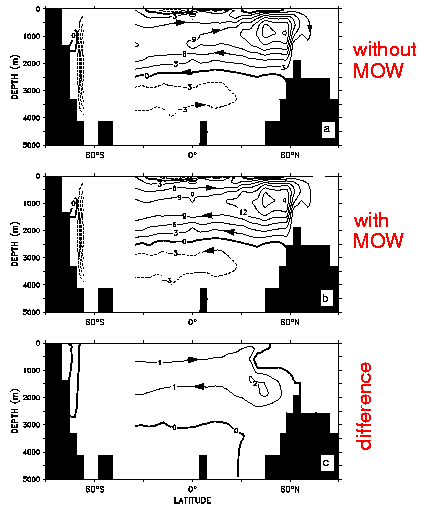 |
| Figure 3. Transport stream function for the Atlantic; (a) for the control experiment, (b) for the experiment with Mediterranean Water, and (c) for the difference between the two. Units are in sverdrup (Sv). |
The results discussed here suggest that the outflow of Mediterranean
water has a small but noticeable effect on the circulation and climate
of the North Atlantic, leading to a warming of the northern North
Atlantic by a few tenths of a degree and an enhancement of the outflow
of North Atlantic Deep Water by 1-2 Sv. However, the change in Mediterranean
outflow which might occur over the next centuries due to the hydrological
imbalance created by the Aswan Dam and other causes is far too small
to have any noticeable effect. It is likely to be completely swamped
by the direct effect of changing precipitation patterns over the
North Atlantic due to both manmade and natural climatic
changes.
References
Fairbanks, R. G., A 17,000-year glacio-eustatic sea level record: influence of glacial melting rates on the Younger Dryas event and deep-ocean circulation, Nature, 342, 637-642, 1989.
Johnson, R. G., Climate control requires a dam at the Strait of Gibraltar, Eos Trans. AGU, 78 (27), 277, 280-281, 1997.
Levitus, S., R. Burgett, and T. Boyer, World Ocean Atlas 1994, Vol. 3: Salinity, 150 pp., U.S. Government Printing Office, Washington, D.C., 1994.
Manabe, S., and R. J. Stouffer, Multiple-century response of a coupled ocean-atmosphere model to an increase of atmospheric carbon dioxide, J. Clim., 7, 5-23, 1994.
Rahmstorf, S., On the freshwater forcing and transport of the Atlantic thermohaline circulation, Clim. Dyn., 12, 799-811, 1996.
Rahmstorf, S., Risk of sea-change in the Atlantic, Nature, 388, 825-826, 1997.
Rahmstorf, S., and J. Willebrand, The role of temperature feedback in stabilizing the thermohaline circulation, J. Phys. Oceanogr., 25, 787-805, 1995.
Rahmstorf, S., J. Marotzke, and J. Willebrand, Stability of the thermohaline circulation, In The warm water sphere of the North Atlantic ocean, edited by W. Krauss, pp. 129-158, Borntraeger, Stuttgart, Germany, 1996.