| Box 3-9: Multi-stakeholder
processes Engaging stakeholders means recognising that each and every actor has a valid view and relevant information to contribute to a task. Multi-stakeholder processes are increasingly encouraged as they encourage better decision-making by ensuring that the views of main actors are incorporated and that a consensus is reached (Hemmati, 2002). Facilitating multi-stakeholder processes requires willingness to participate on the part of the stakeholders. It also requires a sensitive and delicate process of facilitation. The facilitator must, therefore, be able to adapt to varying circumstances and be willing to deviate from a plan, if needs arise, whilst still ensuring that the end goal is achieved. A number of books and guidance tools exist around such participatory processes: Chambers, R. 2002. Participatory Workshops: A Source Book of 21 Sets of Ideas and Activities. Earthscan. Available from http://www.earthscan.co.uk/. Good source book of information about how to run workshops including lots of practical advice and common mistakes. Coalition for Agrarian Reform and Rural Development (ANGOC) and International Institute of Rural Reconstruction (IIRR). 2001. Enhancing Ownership and Sustainability: A Resource Book on Participation. International Fund for Agricultural Development (IFAD). e-mail:publications@iirr.org. A collection of short reviews of participatory approaches and experiences. Pretty, J.N., I. Guijt, I. Scoones and J. Thompson. 1995. Participatory Learning and Action: A Trainers Guide. International Institute for Environment and Development (IIED). Available from http://www.earthprint.com. A valuable collection of advice, tips, and methods for participatory approaches. The focus is mostly on participatory rural appraisal but much would also be relevant to APF workshops. Kaner, S., L. Lind, C. Toldi, S. Fisk and D. Berger. 1996. Facilitator’s Guide to Participatory Decision-Making. New Society Publishers. An introduction to how to build consensus and make sustainable agreements with groups. Also gives advice on how to handle difficult group dynamics and individuals. |
| Case study: CRiSTAL Screening Tool CRiSTAL (Community-based Risk Screening Tool – Adaptation and Livelihoods) is a screening tool designed to help project designers and managers integrate risk reduction and climate change adaptation into community-level projects. It helps project designers and managers:
works through eliciting answers to four questions divided into two modules:
Ecuador, Guatemala, Haiti, Honduras, Nicaragua and Peru); Africa (Ethiopia, Kenya, Mali, Niger, Tanzania and Zambia) and Asia (Sri Lanka) (www.cristaltool.org) For more information, see www.cristaltool.org |
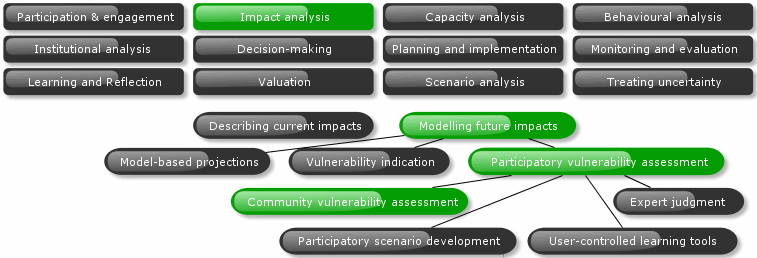
| Case study: CARE Community Vulnerability and Capacity Assessment process CARE created its Community Vulnerability and Capacity Assessment (CVCA) process in order to analyse the various factors that determine vulnerability to climate change. The process involves participatory analysis, which engages all stakeholders in understanding climate-related challenges, identifying adaptation solutions, and taking steps towards those solutions. As with all participatory approaches, the process provides a framework for dialogue within communities, as well as between communities and other stakeholders. The CVCA handbook is currently available in English, Spanish, French and Portuguese, and provides an overview of the methodology, as well as practical guidance for using it in the design and implementation of adaptation actions. One example of the use of the CVCA process was in Ecuador, Peru and Bolivia for the Regional Project for Adaptation to the Impact of Rapid Glacier Retreat in the Tropical Andes (PRAA). Glacial retreat not only limits water availability, but also increases exposure to geomorphological hazards, such as landslides, mudslides and lake outbursts. Use of CVCA highlighted the differential nature of vulnerabilities, and thereby enabled appropriate adaptation responses to be identified. For more information, see www.careclimatechange.org/cvca |
Related decision tree of the Pathfinder:
| Decision tree: Impact analysis |

|