
|
|
|
|
|
|
 |
|||
|
||||
|
 |
|||
|
|
|
|
|
|
Werner von Bloh
 |
|
|
|||
|
Parallel LPJmL |
|
|||
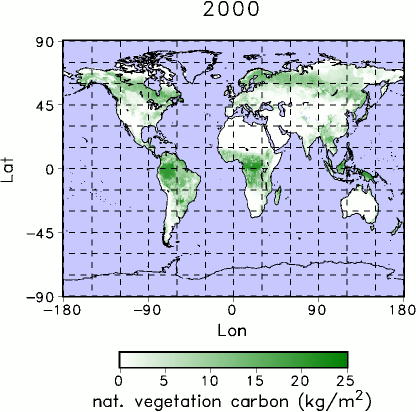
Figure: Global distribution of vegetation carbon in the year 2000. LPJmL is a dynamic global vegetation model (DGVM) with managed land use and river routing. It has been successfully parallelized using the message-passing library (MPI). The latest version is 4.0.002 and can be downloaded from a Github repository:
Additional information can be obtained from the LPJ & LPJmL Web Distribution Portal. The river routing part has been parallelized using a library for distributed networks (von Bloh, 2008; von Bloh et al., 2010). Publications 83. V. Porwollik, S. Rolinski, J. Heinke, W. von Bloh, S. Schaphoff, and C. Müller, 2022. The role of cover crops for cropland soil carbon, nitrogen leaching, and agricultural yields - a global simulation study with LPJmL (V. 5.0-tillage-cc). Biogeosciences 19, 957-977. (doi:10.5194/bg-19-957-2022). B. Sakschewski,W. von Bloh, M. Drüke, A. A. Sörensson , R. Ruscica F. Langerwisch, M. Billing, S. Bereswill, M. Hirota, R. Silva Oliveira, J. Heinke, and K. Thonicke, 2021. Variable tree rooting strategies are key for modelling the distribution, productivity and evapotranspiration of tropical evergreen forests. Biogeosciences 18, 4091-4116 (doi:10.5194/bg-18-4091-2021). M. Drüke, W. von Bloh, St. Petri, B. Sakschewski, S. Schaphoff, M. Forkel, W. Huiskamp, G. Feulner and K. Thonicke, 2021. CM2Mc-LPJmL v1.0: biophysical coupling of a process-based dynamic vegetation model with managed land to a general circulation model. Geoscientific Model Development 14, 4117-4141 (doi:10.5194/gmd-14-4117-2021). Y. Janis, W. von Bloh, S. Schaphoff and C. Müller, 2021. Global cotton production under climate change - Implications for yield and water consumption. Hydrol. Earth Syst. Sci., 25, 2027-2044 (doi:10.5194/hess-25-2027-2021). K. Thonicke, M. Billing, W. von Bloh B. Sakschewski Ü. Niinemets, J. Penuela, J. . C. Cornelissen, Y. Onoda, P. van Bodegom, M. E. Schaepman, F. D. Schneider and A, Walz, 2020. Simulating functional diversity of European natural forests along climatic gradients. Journal of Biogeography, doi:10.1111/jbi.13809.
M. Forkel, M. Drüke, M. Thurner, W. Dorigo, S. Schaphoff, K. Thonicke, W. von Bloh, and N. Carvalhais, 2019. Constraining modelled global vegtation dynamics and carbon turnover using multiple satellite observations. Scientific Reports 9, doi:10.1038/s41598-019-55187-7. A. Boit, B. Sakschewski, L. Boysen, A. Cano-Respo, J. Clement, N. G. Alaniz, K. Kok, M. Kolb, F. Langerwisch, A. Rammig, R. Sachse, M. van Eupen, W. von Bloh, D. C. Zemp, and K. Thonicke, 2019, Using dynamic global vegetation models (DGVMs) for projecting ecosystem services at regional scales. In: M. Schröter, A. Bonn, S. Klotz, R. Seppelt, and C. Baessler (eds.), Atlas of Ecosystem Services. Springer, Cham. 57-61. M. Drüke, M. Forkel, W. von Bloh, B. Sakschewski, M. Cardoso, M. Bustamante, J. Kurths, and K. Thonicke, 2019. Improving the LPJmL4-SPITFIRE vegetation-fire model for South America using satellite data. Geoscientific Model Development 12, 5029-2054 (article). H. Biemans, C. Siderius, A. F. Lutz, S. Nepa, B. Ahmad, T. Hassan, W. von Bloh, R. R. Wijngaard, P. Wester, A. B. Shrestha and W. W. Immerzeel, 2019. Importance of snow and glacier meltwa ter for agriculture on the Indo-Gangetic Plain. Nature Sustainability 2, 594-601 (article). F. Lutz, T. Herzfeld, J. Heinke, S. Rolinski, S. Schaphoff, W. von Bloh, J. J. Stoorvogel, and C. Müller, 2019. Simulating the effect of tillage practices with the global ecosystem model LPJmL (version 5.0-tillage). Geoscientific Model Development 12, 2419-2440 (article). W. von Bloh, S. Schaphoff, C. Müller, S. Rolinski, K. Waha, and S. Zaehle, 2018. Implementing the nitrogen cycle into the dynamic global vegetation, hydrology, and crop growth model LPJmL (version 5.0). Geoscientific Model Development 11, 2789-2812. S. Schaphoff, M. Forkel, C. Müller, J. Knauer, W. von Bloh, D. Gerten, J. Jägermeyr, W. Lucht, A. Rammig, K. Thonicke, and K. Waha, 2018. LPJmL4 - a dynamic global vegetation model with managed land: Part II - Model evaluation. Geoscientific Model Development 11, 1377-1403. S. Schaphoff, W. von Bloh, A. Rammig, K. Thonicke, H. Biemans, M. Forkel, D. Gerten, J. Heinke, J. Jägermeyr, J. Knauer, F. Langerwisch, W. Lucht, C. Müller, S. Rolinski, and K. Waha, 2018. LPJmL4 - a dynamic global vegetation model with managed land: Part I - Model description. Geoscientific Model Development 11, 1343-1375. F. Langerwisch, T. Vaclavik, W. von Bloh, T. Vetter, and K. Thonicke, 2017. Combined effects of climate and land-use change on the provision of ecosystem services in rice agro-ecosystems. Environmental Research Letters 13, doi:10.1088/1748-9326/aa954d. B. Sakschewski, W. von Bloh, A. Boit, L. Poorter, M. Peña-Claros, J. Heinke, J. Joshi, and K. Thonicke, 2016. Resilience of Amazon forests emerges from plant trait diversity. Nature Climate Change, doi:10.1038/nclimate3109. A. Boit, B. Sakschewski, L. Boysen, A. C. Crespo, J. Clement, N. G. Alaniz, K. Kok, M. Kolb, F. Langerwisch, A. Rammig, R. Sachse, M. van Eupen, W. von Bloh, D. Zemp, and K. Thonicke, 2016. Large-scale impact of climate change versus land-use change on future biome shifts in Latin America. Global Change Biology, doi: 10.1111/gcb.13355. C. Müller, E. Stehfest, J. van Minnen, B. Strengers, W. von Bloh, S. Schaphoff, A. Beusen, T. Kram, and W. Lucht, 2016. Drivers and patterns of land biosphere carbon balance reversal. Env. Res. Lett 11, doi:10.1088/1748-9326/11/4/044002. M. Fader, S. Shi, W. von Bloh, A. Bondeau, and W. Cramer, 2016. Mediterranean irrigation under climate change: more efficient irrigation needed to compensate increases in irrigation water requirements. Hydrol. Earth Syst. Sci. 20, 953-973 (article). M. Fader, W. von Bloh, S. Shi, A. Bondeau, and W. Cramer, 2015. Modelling Mediterranean agro-ecosystems by including agricultural trees in the LPJmL model. Geoscientific Model Development 8, 3545-3561 (article). S. Rolinski, A. Rammig, A. Walz, W. von Bloh, M. van Oijen, and K. Thonicke, 2015. A probabilistic risk assessment for the vulnerability of the European carbon cycle to extreme events: the ecosystem perspective. Biogeosciences 12, 1813-1831 (article). B. Sakschewski, W. von Bloh, A. Boit, A. Rammig, J. Kattge, L. Poorter, J. Penuelas, and K. Thonicke, 2015. Leaf and stem economics spectra drive diversity of functional plant traits in a dynamic global vegetation model. Global Change Biology, doi: 10.1111/gcb12870. A. Rammig, M. Wiedermann, J. Donges, G. Babs, W. von Bloh, D. Frank, K. Thonicke, and M. Mahecha, 2015. Coincidences of climate extremes and anomalous vegetation responses: comparing tree-ring patterns to simulated productivity. Biogeosciences 12, 373-385 (article). M. Forkel, N. Carvalhais, S. Schaphoff, W. von Bloh, M. Migliavacca, M. Thurner, and K. Thonicke, 2014. Identifying environmental controls on vegetation greeness phenology through model-data integration. Biogeosciences 11, 7025-7050 (article). B. Sakschewski, W. von Bloh, V. Huber, and A. Bondeau, 2014. Feeding 10 billion people under climate change: How large is the production gap of current agricultural systems?. Ecol. Model. 288, 103-111. F. Joos, R. Roth, J. S. Fuglestvedt, G. P. Peters, I. G. Enting, W. von Bloh, V. Brovkin, E. J. Burke, M. Eby, N. R. Edwards, T. Friedrich, T. L. Frölicher, P. R. Halloran, P. B. Holden, C. Jones, T. Kleinen, F. T. Mackenzie, K. Matsumoto, M. Meinshausen, G.-K. Plattner, A. Reisinger, J. Segschneider, G. Shaffer, M. Steinacher, K. Strassmann, K. Tanaka, A. Timmermann, and A. J. Weaver, 2013.Carbon dioxide and climate impulse response functions for the computation of greenhouse gas metrics: a multi-model analysis. Atmos. Chem. Phys. 13, 2793-2825 (article). S. Franck, W. von Bloh, C. Müller, A. Bondeau, B. Sakschewski, 2011. Harvesting the Sun: New estimations of the maximum population of planet Earth. Ecol. Mod. 222(12), 2019-2026. H. Biemans, I. Haddeland, P. Kabat, F. Ludwig, R. W. A. Hutjes, J. Heinke, W. von Bloh, and D. Gerten, 2010. Impact of reservoirs on river discharge and irrigation water supply during the 20th century. Water Resources Research 47, W03509, doi:10.1029/2009WR008929. W. von Bloh, S. Rost, D. Gerten, and W. Lucht, 2010. Efficient parallelization of a dynamic global vegetation model with river routing. Environmental Modelling & Software 25, 685-690. D. Gerten, S. Rost, W. von Bloh, and W. Lucht, 2008. Causes of change in 20th century global river discharge. Geophys. Res. Lett. 35, L20405. W. von Bloh, 2008. Sequential and Parallel Implementation of Networks. In: P. beim Graben, C. Zhou, M. Thiel, and J. Kurths (eds.), Lectures in Supercomputational Neuroscience, Dynamics in Complex Brain Networks, Springer, Berlin, 279-318. |
|||||
|
|
|||||


|
|
|
|
| Impressum © PIK 2006 |